Peppermint Oil for Dandruff: Lab Papers vs Dermatologists
The tingle peppermint oil gives a scalp is a sensation. It is not evidence that anything has changed about flaking, and no paper we could find shows that it does. If you have persistent dandruff or an itchy scalp, the products with evidence behind them are a short, published list, and none of them is an essential oil. Here is that list, what the laboratory papers on peppermint and scalp yeast amount to, and why menthol on an already irritated scalp can make matters worse.
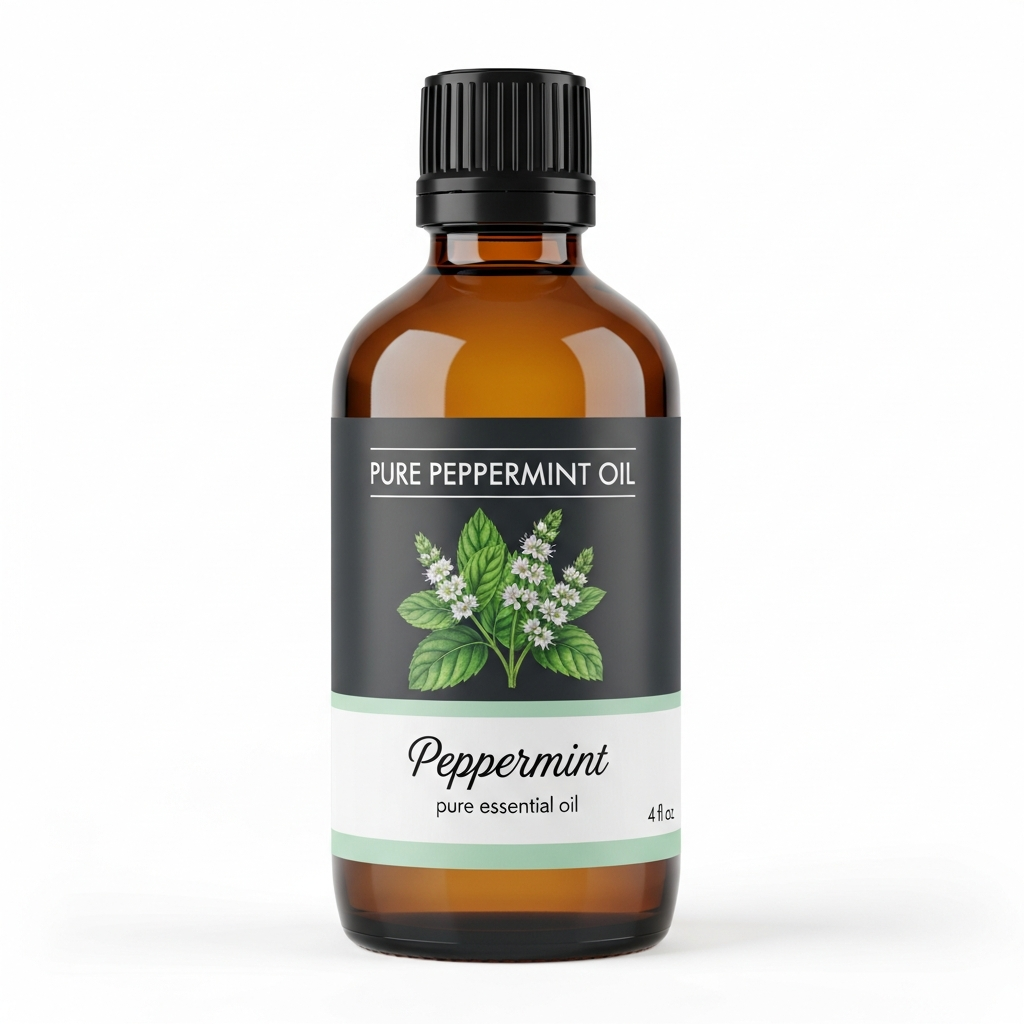
Peppermint Essential Oil
Our own Peppermint Essential Oil, in sizes from 0.5 oz to bulk.
From $10.99
Shop Now →What dandruff products actually contain
The American Academy of Dermatology says poor hygiene is a myth and that "causes range from oily skin to hair care habits, along with some medical conditions." For a persistent case it points to shampoos containing one of zinc pyrithione, salicylic acid, sulfur, selenium sulfide, ketoconazole or coal tar, says some need to sit on the scalp for about 5 to 10 minutes before rinsing, suggests alternating between products with different actives if one stops working, and says to see a board-certified dermatologist if home care does not help (AAD).
The FDA's regulation at 21 CFR 358.710 fixes which actives may be sold to control dandruff and at what strength (21 CFR 358.710):
| Active | Permitted strength for dandruff |
|---|---|
| Coal tar | 0.5% to 5% |
| Pyrithione zinc | 0.3% to 2% (wash-off); 0.1% to 0.25% (leave-on) |
| Salicylic acid | 1.8% to 3% |
| Selenium sulfide | 1% (0.6% micronized) |
| Sulfur | 2% to 5% |
Peppermint oil, menthol and every other essential oil are absent from that list. That absence is part of why we make no dandruff claim. The FDA also says a product's status "is determined by a product's intended use" (FDA). Our oils are sold for fragrance and soap and product making.
The yardstick: the best-known essential-oil trial is for a different oil
When people argue that an essential oil can handle dandruff, the trial they cite is Satchell and colleagues (J Am Acad Dermatol, 2002): 126 people aged 14 and over with mild to moderate dandruff used a 5% tea tree oil shampoo or a placebo shampoo daily for four weeks, single-blind. The scalp severity score improved 41% with tea tree oil and 11% with placebo (P < .001), and self-rated itchiness and greasiness improved; self-rated scaliness improved but not significantly. No adverse effects were reported.
Notice what that is and is not. It is a different oil (Melaleuca alternifolia), in a shampoo that is rinsed off, at 5%. Peppermint oil has no equivalent trial that we could find, and a 5% concentration is two and a half times the 2% top of our own copy (our arithmetic). Even the best-known example does not transfer to our oils.
What we found when we searched for peppermint and scalp yeast
Laboratory papers that test essential oils against Malassezia yeasts, which live on skin including the scalp, turn up in nearly every "natural dandruff" list. On 29 October 2026 we ran two searches on Europe PMC. Malassezia with peppermint or Mentha piperita returned 97 records. Peppermint or Mentha piperita with dandruff or seborrheic dermatitis returned 139. We read the titles and journals of the first 15 and first 25 results respectively, not the abstracts. In those, there was no clinical trial of peppermint oil on dandruff. The closest matches were papers testing blends of several oils against Malassezia furfur in a dish (one 2025 paper names lemongrass, kaffir lime, lime, dill and shatavari, not peppermint), a veterinary study of essential oils combined with chlorhexidine against the dog yeast Malassezia pachydermatis, and general reviews of plant extracts in skin care. A search that reads only the first page cannot prove an absence. What it does show is that a reader who sees "studies show peppermint fights dandruff yeast" is being pointed to dish experiments, not to people with flaking scalps.
The reason that gap matters is plain. In a dish, an oil meets yeast directly at whatever concentration the researchers choose. On a scalp, the oil would have to be diluted, would be spread through hair, would be rinsed or absorbed, and would sit on skin that may already be irritated. A result at the first step cannot be carried to the last.
The cooling sensation, and why itchy skin is the worst place to try it
The cooling feel comes from menthol activating a cold-sensing channel in sensory nerve endings (McKemy, Neuhausser and Julius, Nature, 2002, which identified the menthol-sensitive receptor in trigeminal neurons that also responds to cool-to-cold temperatures). That paper describes the receptor, not any effect on flaking. A cooling feel can mask itch for a moment. It does not tell you the cause is addressed.
Meanwhile the irritation side is documented. NCCIH says applying peppermint oil to the skin "can include skin rashes and irritation" (NCCIH, May 2025). The Cosmetic Ingredient Review's 2018 re-review reports positive patch-test reactions to peppermint oil in 8 of 9 published case reports in patients with diseased skin, and in a North American Contact Dermatitis Group data set a 0.53% positive rate for peppermint oil at 2% in petrolatum (CIR, 2018). CIR also reports that testing the components in three patients with allergic contact dermatitis pointed to menthol and trace components. Those figures are for peppermint (Mentha piperita) oil; we found no equivalent published data for cornmint oil. A scalp with scaling, redness or a rash is exactly the skin in which a reaction is most likely to be missed or to be confused with the original problem.
If you still want peppermint near your scalp
- See the dermatologist first if the problem persists. The AAD says to book one when home care does not help. Itch with redness, oozing, thick patches, or hair loss is a reason not to experiment.
- Dilute, and keep it low. Our copy says 0.5% to 2% in a carrier oil, never neat. For the scalp we recommend 0.5% to 1%. CIR reports a highest cosmetic use level of 5% (2017) and a Tisserand and Young maximum of 5.4% (read second-hand through CIR); both exceed our 2% and are not targets. Arithmetic: 1% of an ounce (29.57 ml) of carrier is about 0.3 ml of oil, or 6 drops at 20 per ml.
- Patch test. The AAD method for a new product: a quarter-sized spot on the inner arm or elbow bend, the normal amount, twice a day for 7 to 10 days. If redness, itching or swelling appears, wash it off and do not use it again (AAD).
- Keep it out of eyes and away from the faces of young children. NCCIH says peppermint oil should not be applied to the face of infants or young children. Our own pages say the same.
Our two oils are Mentha piperita and Mentha arvensis (cornmint). The certificate of analysis we publish is a refractive index for a piperita sample, and the GC-MS report we publish is for the cornmint oil and gives only chemical-family totals; neither lists menthol, menthone or pulegone, so neither says how irritating a particular batch might be. We sell no shampoo, no scalp product and no remedy.
For the tingle on its own terms, our scalp routine post covers the steps, the rosemary comparison covers the hair-growth studies, and the dilution guide and safety basics cover the percentages.
If you want peppermint as a scent, ours are sold neat and meant to be diluted before they touch skin.
Peppermint Essential Oil
Peppermint Essential Oil from our own shop, in sizes from 0.5 oz to bulk.
From $10.99
Shop Now →Sources & Further Reading
- American Academy of Dermatology. Dandruff shampoos: dermatologists' tips (news page). aad.org/news (dandruff)
- American Academy of Dermatology. How to test skin care products. aad.org/public/everyday-care
- US FDA via Cornell LII. 21 CFR 358.710, Active ingredients for the control of dandruff, seborrheic dermatitis, or psoriasis. law.cornell.edu/cfr/text/21/358.710
- US FDA. Is it a cosmetic, a drug, or both? (Or is it soap?) fda.gov/cosmetics
- Satchell AC et al., 2002. Treatment of dandruff with 5% tea tree oil shampoo. J Am Acad Dermatol 47:852-855. pubmed/12451368
- McKemy DD, Neuhausser WM, Julius D, 2002. Identification of a cold receptor reveals a general role for TRP channels in thermosensation. Nature 416:52-58. pubmed/11882888
- NCCIH (NIH), May 2025. Peppermint Oil: Usefulness and Safety. nccih.nih.gov/health/peppermint-oil
- Cosmetic Ingredient Review, 2018. Amended Safety Assessment of Mentha piperita (Peppermint)-Derived Ingredients as Used in Cosmetics. cir-safety.org/pepper032018rep.pdf
- Europe PMC literature searches run 29 October 2026 (Malassezia with peppermint/Mentha piperita, 97 records; peppermint/Mentha piperita with dandruff or seborrheic dermatitis, 139 records). europepmc.org