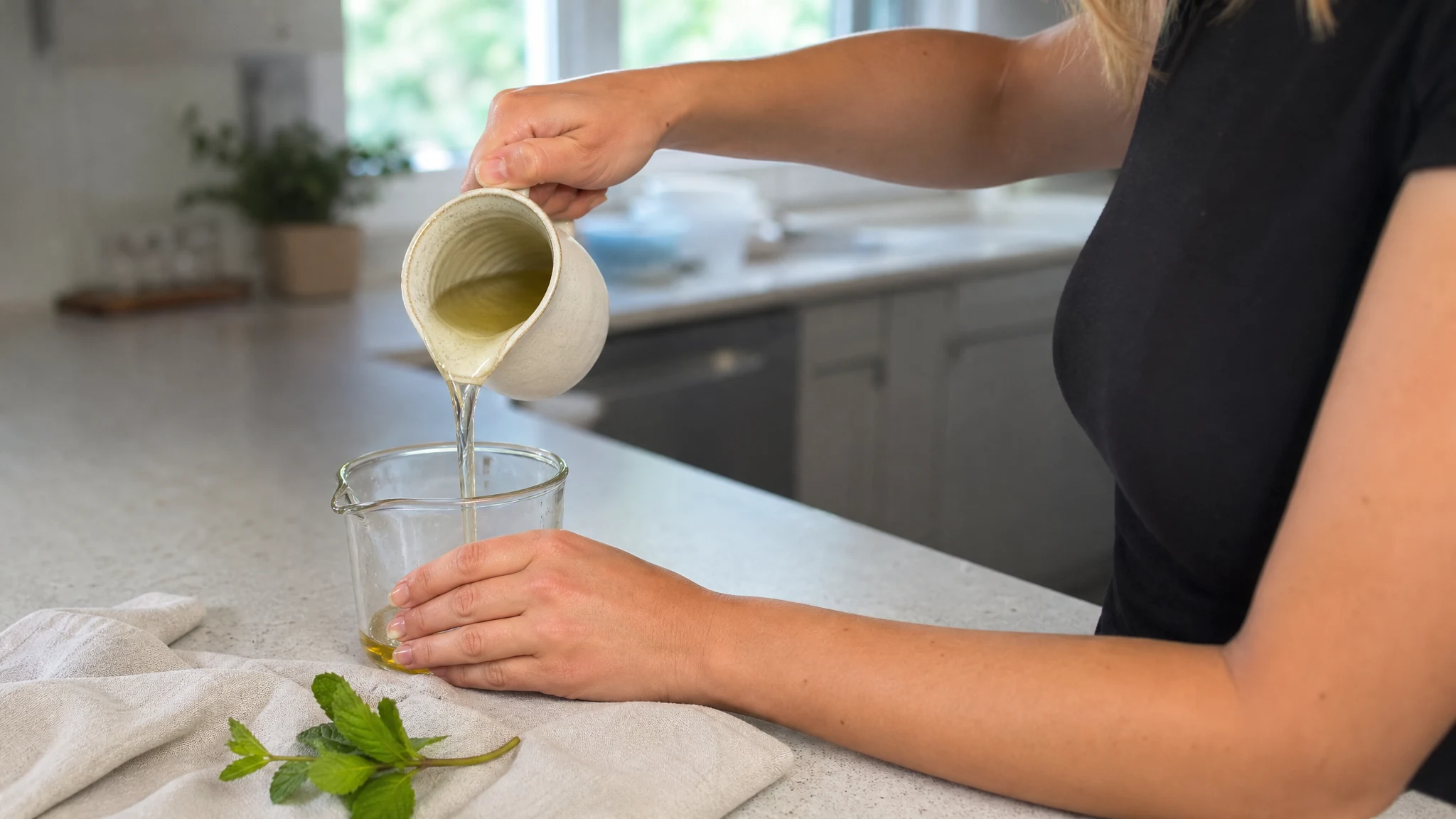
How to Dilute Peppermint Oil: Percentages, Drops and Limits
The unit for diluting peppermint oil is a percentage, not a drop count, and a drop count on a chart is only as good as the dropper behind it. Our own copy says to dilute to 0.5% to 2% in a carrier oil and patch test first, and our distillation page says to use "one drop where you would use three of something gentler." This page turns those percentages into milliliters and drops, shows where published figures sit above and below them, and gives the arithmetic for fixing a batch where too much went in.
Peppermint Essential Oil
Our own Peppermint Essential Oil, in sizes from 0.5 oz to bulk.
From $10.99
Shop Now →The chart: percentage first, drops second
Milliliters of oil are the percentage times the milliliters of carrier. Drops below are at 20 drops per milliliter, the convention in our copy, and 1 oz is 29.57 ml. Our peppermint oils are sold neat, so every figure is yours to make.
| Strength | In 10 ml carrier | In 1 oz (29.57 ml) | In 100 ml |
|---|---|---|---|
| 0.5% | 0.05 ml (1 drop) | 0.15 ml (3 drops) | 0.5 ml (10 drops) |
| 1% | 0.10 ml (2 drops) | 0.30 ml (6 drops) | 1.0 ml (20 drops) |
| 2% | 0.20 ml (4 drops) | 0.59 ml (12 drops) | 2.0 ml (40 drops) |
For anything larger than a roller bottle, weigh instead. The CIR gives a specific gravity of 0.896 to 0.908 for peppermint oil (a general specification for the oil, not a figure for ours), so 1 ml is about 0.9 g, and 1% of 100 g of blend is 1 g of oil. A scale that reads to 0.01 g removes the dropper from the problem.
Why drops lie
The Tisserand Institute reviewed three studies from 1999, 2000 and 2016 covering 1, 25 and 23 essential oils on 3 to 7 styles of dropper. Twenty drops averaged 0.66 g every time, but the number of drops per milliliter varied from about 20 to 40, and the author notes that "a drop is never a precise measure" (Tisserand Institute). Its own dilution chart assumes 30 drops per milliliter.
Our arithmetic shows what that spread does. Take "12 drops in an ounce." With a 20 drops-per-ml dropper that is 0.6 ml, or 2%. With a 40 drops-per-ml dropper it is 0.3 ml, or 1%. Use a chart built for one dropper with another and the error is a factor of two, in the direction that irritates. Also, 0.66 g per 20 drops at about 0.9 g/ml works out to roughly 27 drops per ml for peppermint oil, between the two conventions. Percentages by volume or weight survive a change of bottle; drop counts do not.
What the published limits say, and how they compare with 0.5% to 2%
Every published figure we could verify sits above our range, none below it, and none is a limit for our oils. They are general figures for Mentha x piperita oil.
- 5.4% maximum dermal use level for peppermint oil, from Tisserand and Young's Essential Oil Safety, as quoted by the Cosmetic Ingredient Review (CIR). We read it second-hand, in the CIR report, not in the book. The CIR says it is based on 8% menthofuran and 3% pulegone content, with limits of 0.5% for menthofuran and 1.2% for pulegone, and that the authors advise avoiding the oil altogether in cardiac fibrillation and glucose-6-phosphate dehydrogenase (G6PD) deficiency. Our 2% is 37% of 5.4%. That does not make 5.4% a target; it is a ceiling computed for one composition, and the composition of any given bottle is a variable we cannot document.
- 5% highest reported use in cosmetics, in face and neck leave-on products (2017), up from 3% in 1997. The CIR Expert Panel concluded the oil is "safe in cosmetics in the present practices of use and concentration when formulated to be non-sensitizing" (CIR, final amended report, June 2018). That describes what industry reported using, not a dose chosen for a home blend.
- Human skin tests. The report cites two human repeated insult patch tests of 20% peppermint oil (104 and 101 subjects) with no irritation or sensitization reported. It also describes a North American Contact Dermatitis Group multicenter study in which peppermint oil at 2% in petrolatum gave a positive reaction prevalence of 0.53%. Positive patch tests to the oil were reported in 8 of 9 case reports on patients with diseased skin.
We could not verify any published maximum for cornmint (Mentha arvensis) oil, and no published fragrance-industry limit for either oil turned up in this batch's source search. So for the arvensis oil there is no number to cite, and the low end applies with more reason.
What we recommend. For face, scalp and body, stay at 0.5% to 1%, and treat 2% as the top of what our copy supports. That is our position, reasoned from two things: menthol irritates, and peppermint is potent by our distillation page's own account. It is not a tested threshold. Keep any blend away from eyes. Do not use it near the face of an infant or young child. If a rash appears, stop; a dermatologist or allergist is the person who can tell irritation from allergy. Our skin post and application-sites post go further.
Oil into water does not dilute, it floats
Dilution only works in a carrier that dissolves the oil. The CIR's specification for peppermint oil describes it as soluble in most vegetable oils and insoluble in propylene glycol, and soluble in alcohol (1 volume in 3 volumes of 70% alcohol). Water is the problem. PubChem records menthol, the main component, at about 420 to 456 mg per liter of water at 25 C (menthol alone, not the whole oil). A 1% blend in water is 10 g of oil per liter; if the oil is 30% to 55% menthol (the range the CIR gives for the oil), that is 3 to 5.5 g of menthol per liter, roughly ten times what water holds. The remainder floats as droplets that land on skin undiluted. That is the arithmetic behind the advice for sprays, baths and shampoos: use a cosmetic solubilizer or emulsifier made for essential oils, bought from a supply shop, with its own safety data sheet and directions. We do not sell them and will not guess a ratio.
Which dilution for which job
| Use | Our stated position |
|---|---|
| Face, scalp, body leave-on in a carrier oil | 0.5% to 1%; patch test first; 2% is our copy's ceiling |
| Roller bottle for small areas | See rollerball formulas; the same percentages, 10 ml carrier equals 1 to 4 drops |
| Rinse-off (soap, scrub, shampoo) | No verified published limit; start at the low end; a sugar scrub has its own arithmetic to work out |
| Diffuser | Not a dilution question; see diffuser drops |
| Child's face, infant | No dilution from us; ask a pediatrician (why) |
The carrier choice is its own decision, because it sets how long the blend keeps; that is the subject of the carrier comparison.
You added too many drops: the correction
You cannot take drops back out. You can dilute again. In 1 oz (29.57 ml) of carrier at 20 drops per ml:
| Drops added | Resulting strength | Carrier to add for 2% | Carrier to add for 1% |
|---|---|---|---|
| 3 | 0.5% | none needed | none needed |
| 12 | 2.0% | none (at the ceiling) | about 30 ml (double it) |
| 20 | 3.3% | about 19 ml | about 69 ml |
| 30 | 4.8% | about 44 ml | about 120 ml |
The method is total volume = oil volume divided by the target fraction, minus what is already in the bottle. For 20 drops (1 ml) aiming at 2%: 1 ÷ 0.02 = 50 ml total, less 1 ml of oil and 29.57 ml of carrier, which leaves about 19 ml to add. Most people do not have a bottle that large, which is why the sensible fix for a gross overshoot is to start a fresh batch and label the strong one as such. Keep it away from skin, children and pets, and never swallow it.
Nothing here has been made or tested by us; these are calculations from the sources above. Make a small batch first.
Peppermint Essential Oil
Peppermint Essential Oil from our own shop, in sizes from 0.5 oz to bulk.
From $10.99
Shop Now →Sources & Further Reading
- Cosmetic Ingredient Review, 2018. Amended Safety Assessment of Mentha piperita (Peppermint)-Derived Ingredients as Used in Cosmetics, final amended report. cir-safety.org/pepper032018rep.pdf
- Tisserand Institute. How big is a drop? tisserandinstitute.org/learn-more/drop-size
- PubChem (NIH). Menthol, solubility record (NTP, Wakita 1986, Yalkowsky 2010). pubchem.ncbi.nlm.nih.gov/compound/1254