Where to Apply Peppermint Oil: The Avoid List First
The useful half of "where do I put peppermint oil" is the list of places you should not. Menthol is the cooling compound, and the same property that makes the oil feel cool makes it a poor match for eyes, the inside of the nose, the mouth, broken skin and a young child's face. This article sets out the avoid list first, then the single patch-test routine that applies everywhere else, and it gives no condition-specific application points because we make no medical claims.
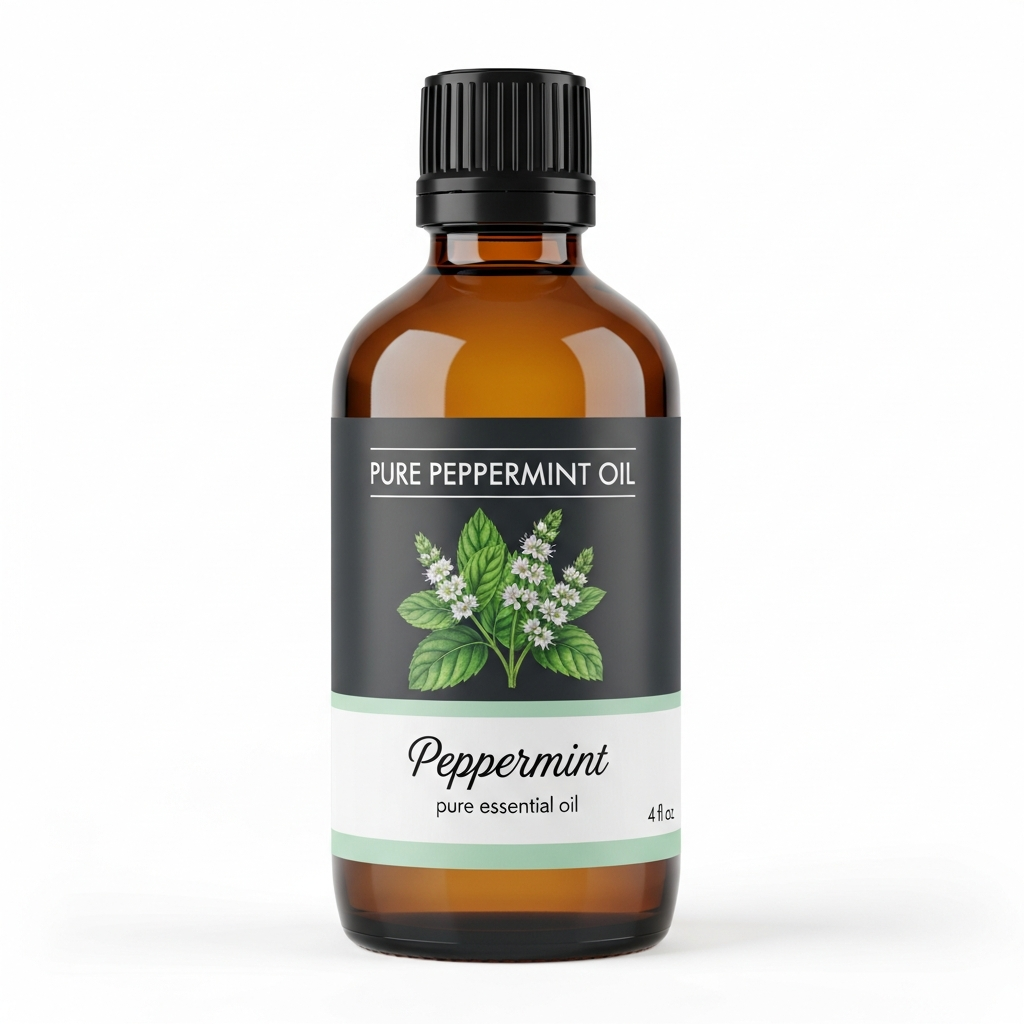
Peppermint Essential Oil
Our own Peppermint Essential Oil, in sizes from 0.5 oz to bulk.
From $10.99
Shop Now →The avoid list
| Place | What the sources say |
|---|---|
| Eyes, and skin close to them | The Missouri Poison Center says to start rinsing the eye with lukewarm water and to call 1-800-222-1222 for further recommendations. The cosmetic-ingredient review of peppermint oil lists only four eye-area products using it, at a maximum of 0.00094 percent. Our lowest suggested dilution, 0.5 percent, is about 530 times that (0.5 divided by 0.00094, our arithmetic). |
| Inside the nose | NCCIH (May 2025) says there is not enough reliable information on safety or side effects when peppermint oil is applied inside the nose. |
| Lips and mouth | Our shop copy says never to take the oil internally. Poison centres say to call if an essential oil has been swallowed. See the separate lips article for what authorities say about that area. |
| Broken or damaged skin | Poison.org says not to use essential oils on damaged skin. |
| Near an infant's or young child's face | Our distillation page says not to. NCCIH (May 2025): menthol "should not be inhaled by or applied to the face of an infant or small child because it may negatively affect their breathing." |
| Under tight wraps or bandages | No source tells us about wraps with peppermint oil. The reasoning is that sensitisation tests in the review used occlusive patches left on for 48 hours, so a wrap is a harsher condition than a bare-skin test. |
The Missouri Poison Center page also says that essential oil left on skin can cause burning and stinging, and to rinse the skin with lukewarm water and soap (Missouri Poison Center). Poison.org adds that children "have thin skin and immature livers" and that a rash means washing the oil off with soap and water (poison.org).
Why the eye number matters for a roller or a dab
A dab on the temple or the side of the neck puts oil within a finger's width of the eyes, and a finger that touched the oil then rubs an eye. If it happens, the Missouri Poison Center's first step is lukewarm water on the eye, then a call to the poison line. Do not wait to see whether it passes. If pain, redness or blurred vision continue after rinsing, see an eye doctor. That last sentence is our recommendation, not a quote; the Missouri page itself stops at the rinse and the call.
What the dilution numbers are, and are not
Our shop copy says to dilute to 0.5% to 2% in a carrier oil and patch test first. Our distillation page adds: use far less than you think you need, one drop where you would use three of something gentler. Here is what the outside sources add, and it is not a limit for our oils.
- The Cosmetic Ingredient Review (final amended report, 2018) records a maximum dermal use level of 5.4% for peppermint oil, attributed to Tisserand and Young's Essential Oil Safety and based on an assumed 8% menthofuran and 3% pulegone content. We cite it as secondary, through the review, not from the book itself.
- The same review reports peppermint oil in cosmetics at up to 5% in face and neck leave-on products and up to 1.9% in rinse-off products, drawn from industry survey data on 815 products.
- Skin reactions are documented. In patients with dermatitis, 7 of 450 reacted to 2% peppermint oil in yellow soft paraffin, and in another study 6 of 86. The North American Contact Dermatitis Group patch-tested 71 patients at 2% in petrolatum, reporting a positive reaction prevalence of 0.53%. In healthy panels there was no sensitisation at 8% (25 men, maximisation test) or at 20% (104 subjects, repeated insult patch test). In patch tests of the components, the allergens were menthol and trace constituents such as piperitone or pulegone (CIR, 2018).
Those results come from peppermint (Mentha piperita) oil. No verified maximum for cornmint (Mentha arvensis) oil was available to us in the sources we could open, so for that oil we have only our own 0.5% to 2% copy. We recommend the low end, 0.5% to 1%, for the face, scalp and body. That is our stated recommendation, reasoned from the potency of menthol and the reaction rates above, not a published limit. A person who has reacted to a fragrance or to menthol, or who has eczema, should ask a dermatologist or allergist before using it at all.
The patch test, step by step
The American Academy of Dermatology's method for testing a new skin product is the one we point to:
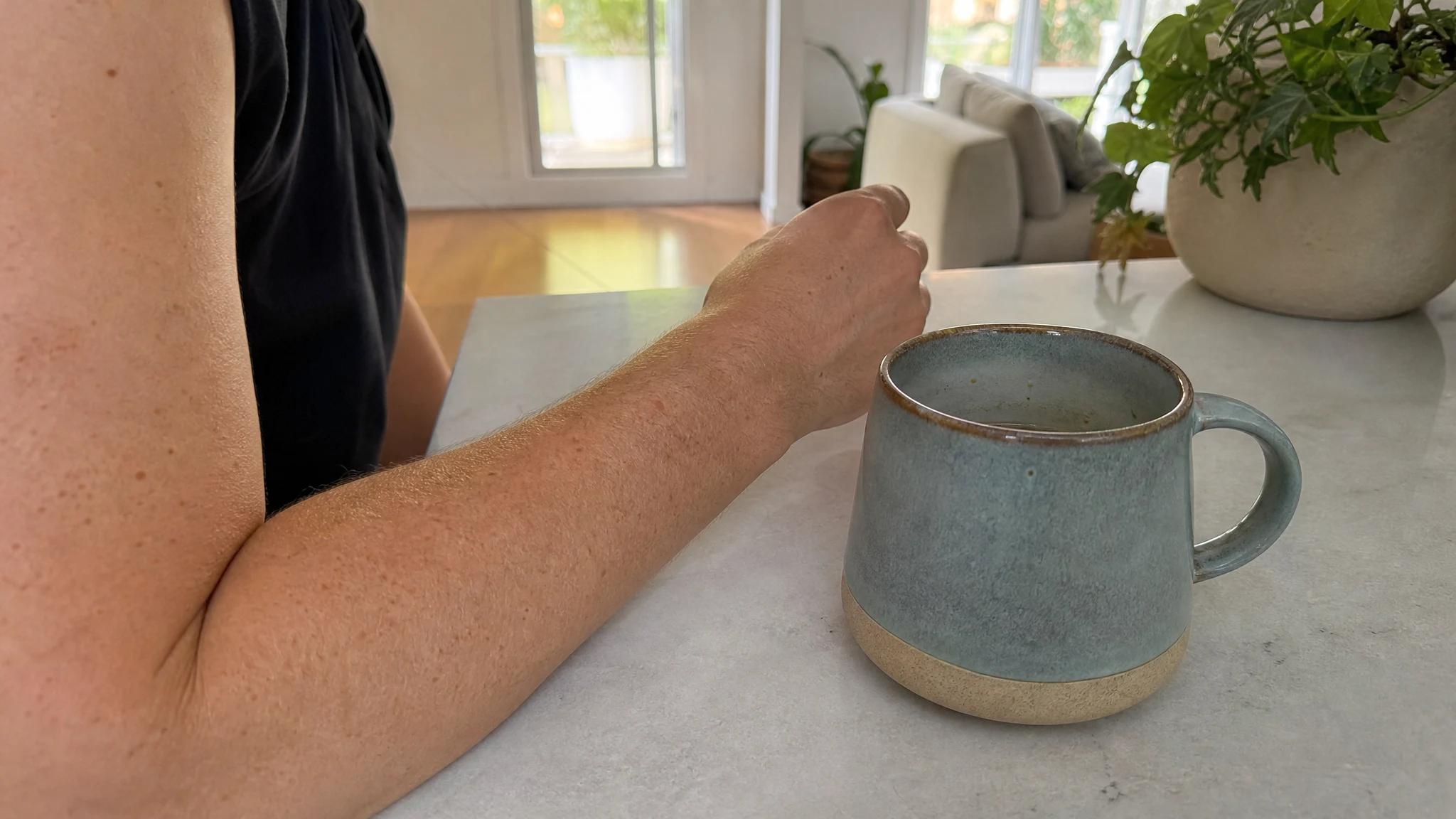
- Pick a spot about the size of a quarter, somewhere the product will not be rubbed or washed away, such as the underside of the arm or the bend of the elbow.
- Apply the amount you would normally use, at the dilution you would actually use. Mix the diluted blend first; do not test the neat oil.
- Repeat twice daily for seven to 10 days.
- If there is no redness, itching or swelling, you can start using the product. If there is, gently wash it off as soon as possible and do not use it again. See a dermatologist if the reaction is severe or does not settle (AAD).
That is a week or more, longer than the 24 hours some brands suggest. Our reading is that a longer test gives a delayed reaction time to show. The AAD page is about skin care products in general, not essential oils specifically, so applying it to a diluted oil is our inference. Every skin product tested this way should also be a blend you have already measured: the steps for doing that are in our dilution guide, the carrier choice is in carrier oils, and a ready-made recipe with the arithmetic is in the rollerball formulas.
What we leave out on purpose
You will find lists of "points" for peppermint oil, each tied to a complaint. We give none. Under U.S. law a product's category depends on its intended use, and the FDA's page on cosmetic or drug lists a massage oil marketed to relieve muscle pain as a drug, where one that only scents and moisturises is a cosmetic (FDA). We sell our two peppermint oils, Mentha piperita and Mentha arvensis, as fragrance material, and the body-part-for-symptom pairing belongs to a clinician. For the general rules see safety basics and, for the skin question itself, peppermint oil for skin.
Put the diluted blend on the large, ordinary skin of the forearm or the calf, wash your hands afterwards, and keep the bottle out of reach of children and pets.
Peppermint Essential Oil
Peppermint Essential Oil from our own shop, in sizes from 0.5 oz to bulk.
From $10.99
Shop Now →Sources & Further Reading
- Missouri Poison Center. Essential oils. missouripoisoncenter.org
- poison.org (America's Poison Centers). Essential oils. poison.org/articles/essential-oils
- NCCIH (NIH), May 2025. Peppermint oil: usefulness and safety. nccih.nih.gov/health/peppermint-oil
- Cosmetic Ingredient Review, 2018. Safety assessment of Mentha piperita (peppermint)-derived ingredients as used in cosmetics (final amended report). cir-safety.org/pepper032018rep.pdf
- American Academy of Dermatology. How to test skin care products. aad.org
- U.S. FDA. Is it a cosmetic, a drug, or both? (Or is it soap?) fda.gov