Carrier Oils for Peppermint Oil: Shelf Life, Allergens First
Pick the carrier for peppermint oil by two questions before skin feel: how long will the blend sit in the bottle, and who might be allergic to it? The carrier, not the peppermint, usually sets how long a diluted blend keeps, because peppermint oil dissolves in most vegetable oils and the carrier is 98% or more of what is in the bottle at our 0.5% to 2% range. We sell no carrier oils; this page compares them on published composition and stability data and says what to ask your supplier.
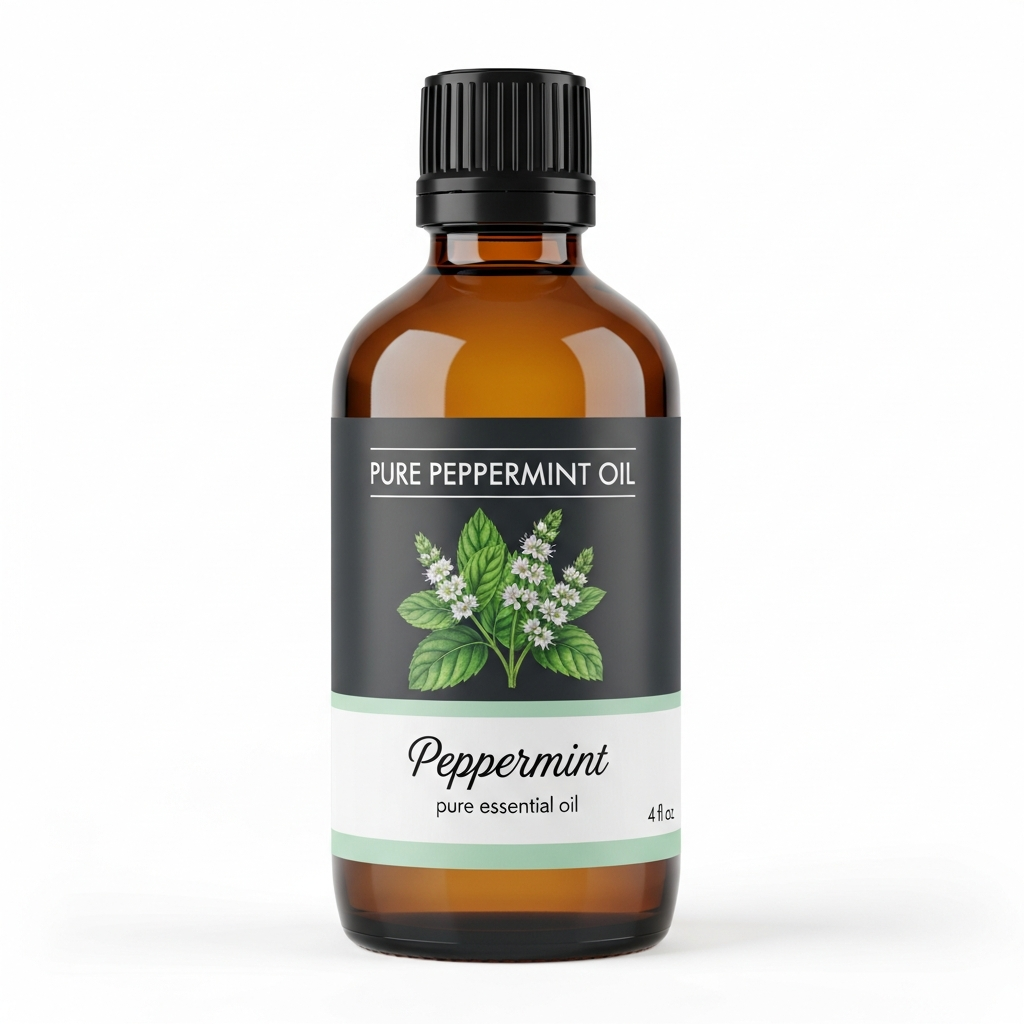
Peppermint Essential Oil
Our own Peppermint Essential Oil, in sizes from 0.5 oz to bulk.
From $10.99
Shop Now →What the numbers say about the usual candidates
Orsavova and colleagues measured the fatty acids of 14 vegetable oils by gas chromatography (Int J Mol Sci, 2015). Values are percent of total fatty acids:
| Oil | Oleic (1 double bond) | Linoleic (2 double bonds) | Saturated, total |
|---|---|---|---|
| Coconut | 6.2 | 1.6 | 92.1 (lauric 47.7, myristic 19.9, caprylic 7.6, capric 5.5) |
| Olive | 66.4 | 16.4 | 19.4 |
| Sweet almond | 67.2 | 22.8 | 9.3 |
| Sunflower | 28.0 | 62.2 | 9.4 |
| Grapeseed | 14.3 | 74.7 | 10.4 |
| Safflower | 11.5 | 79.0 | 9.3 |
Jojoba is not in that table because it is not mainly a triglyceride oil; the 2017 review by Lin, Zhong and Santiago describes it as high in wax esters (Int J Mol Sci, 2017). "Fractionated coconut oil" is also not the coconut oil in the table. We could not fetch a specification for it, so treat it as a processed portion of coconut oil and ask the seller for its fatty acid profile. Our inference from the table is that the caprylic and capric acids (13.1% combined in plain coconut oil) are the saturated, medium-chain part, but the actual percentages in a given bottle are the seller's to state.
Why double bonds decide shelf life
A 2025 review of vegetable oil oxidation reproduces relative oxidation rates for C18 fatty acids at 100 C, citing Talbot (2016), with stearic acid as 1: oleic 10, linoleic 100, linolenic 150 (Gharby et al., Food Chem X, 2025). It also says oxidation roughly doubles for each 10 C rise in temperature, that light accelerates it, and that cutting headspace oxygen from over 15% to 3% extended shelf life from 60 to 180 days in a case it cites.
That lets us do a crude ranking. Multiply each oil's oleic percentage by 10 and its linoleic by 100, and count the saturates at 1 (treating them all as stearic, a simplification). Setting olive oil to 1.0, that gives coconut 0.14, sweet almond 1.3, sunflower 2.8, grapeseed 3.3 and safflower 3.5. This is our arithmetic on two published tables, at 100 C, with no allowance for tocopherols, refining or oxygen; it ranks the risk, it does not predict months. The direction matters for a peppermint blend: a linoleic-rich oil such as grapeseed or safflower is the likeliest to turn first, and a mostly saturated coconut fraction the least. Reasoning from that: the blend is unlikely to outlast the carrier it sits in, so use the carrier supplier's stated shelf life as your ceiling. That is reasoning from the sources, not a measured shelf life.
Jojoba is the odd one out
Tsuchimoto, Sakai and Fukui at Osaka University heated jojoba oil, olive oil and squalene at 60 C for 60 days (BPB Reports, 2022). The acid value did not change in jojoba oil but rose in the others, and jojoba had the lowest peroxide and carbonyl values; the authors called it the most stable of the three. Two limits: it was crude jojoba from different suppliers, and the deodorized and refined oils showed lower antioxidant activity than crude oils. If you buy refined jojoba, the study does not tell you what you have. It also tested olive oil, not coconut or almond, so it does not rank jojoba against them.
Allergen status is a separate, earlier question
If anyone using the blend has a tree nut allergy, sweet almond oil is the carrier to take off the list. The FDA names almonds as an example of the tree nuts that must be declared on food labels; that law covers food, so it tells you almond is a recognized allergen, not how a skin blend should be handled (FDA, content current 11 March 2026). Coconut is a different case: the FDA's fifth-edition allergen guidance, published 6 January 2025, no longer lists coconut as a tree nut (FDA FAQ, updated 26 March 2025). That is a labeling definition. It does not say that nobody reacts to coconut, and an allergist, not a blog, is who decides for a person with a history of reactions. Label a gifted or shared blend with the carrier's name.
Decision table by use
Use the strengths from the dilution page: 0.5% to 1% for face, scalp and body leave-on as our recommendation, and 2% as the top of our copy. Our copy says to patch test and to keep the blend away from eyes, children and pets.
| Use | What the documented properties favor | Watch for |
|---|---|---|
| Body blend you will keep for months | A carrier with few double bonds: a coconut fraction (per the oxidation ranking) or jojoba (per the heating study) | Ask the seller for a best-by date and refined vs crude |
| Scalp or hair blend | Same rule; avoid the linoleic-rich oils if it sits unused | Peppermint near the eyes; the live hair post is generic |
| Roller bottle (10 ml carrier takes 1 to 4 drops at 0.5% to 2%) | A liquid, low-viscosity carrier you can pour; stability as above | Almond if there is any nut allergy in the household |
| Short-term blend used within a few weeks | Any liquid carrier that suits the user; pick by allergen status first | Date it, keep it capped, cool and dark |
One more caution comes from the Lin review. It states that linoleic acid "has a direct role in maintaining the integrity of the water permeability barrier," while oleic acid "causes barrier disruption and eventually induces dermatitis under continuous topical application." The review draws those from the literature; we report them and claim nothing for skin from our oils. If you have eczema or reactive skin, ask a dermatologist before choosing a carrier, because the choice matters more there than any ranking on this page. We found no source we could verify for comedogenicity ratings, so this page does not rank carriers for pores.
What to ask the carrier seller
- The fatty acid profile or certificate of analysis for the lot.
- Whether it is crude, refined or deodorized, and the best-by date.
- The container: opaque or dark glass, with the date you opened it written on it.
- The allergen statement for that product.
Our oils are sold neat in Mentha piperita and Mentha arvensis, so the carrier, its supplier and its shelf life are yours to choose; see rollerball formulas and the foot soak post for formulas.
Peppermint Essential Oil
Peppermint Essential Oil from our own shop, in sizes from 0.5 oz to bulk.
From $10.99
Shop Now →Sources & Further Reading
- Orsavova J, Misurcova L, Ambrozova JV, Vicha R, Mlcek J, 2015. Fatty Acids Composition of Vegetable Oils. Int J Mol Sci 16(6):12871-12890. PMC4490476
- Gharby S et al., 2025. Vegetable oil oxidation: Mechanisms, impacts on quality, and approaches to enhance shelf life. Food Chem X 28:102541. PMC12146556
- Tsuchimoto S, Sakai H, Fukui K, 2022. Oxidative Stability and Antioxidant Activity of Crude Jojoba Oil. BPB Reports 5(6):121-124. jstage.jst.go.jp/bpbreports/5/6/5_121
- Lin TK, Zhong L, Santiago JL, 2017. Anti-Inflammatory and Skin Barrier Repair Effects of Topical Application of Some Plant Oils. Int J Mol Sci, 2017. PMC5796020
- FDA. Food Allergies. fda.gov/food/food-allergies
- FDA, 2025. Frequently Asked Questions: Food Allergen Labeling Guidance for Industry (coconut). fda.gov allergen labeling FAQ
- Cosmetic Ingredient Review, 2018. Amended Safety Assessment of Mentha piperita (Peppermint)-Derived Ingredients (solubility in vegetable oils). cir-safety.org/pepper032018rep.pdf