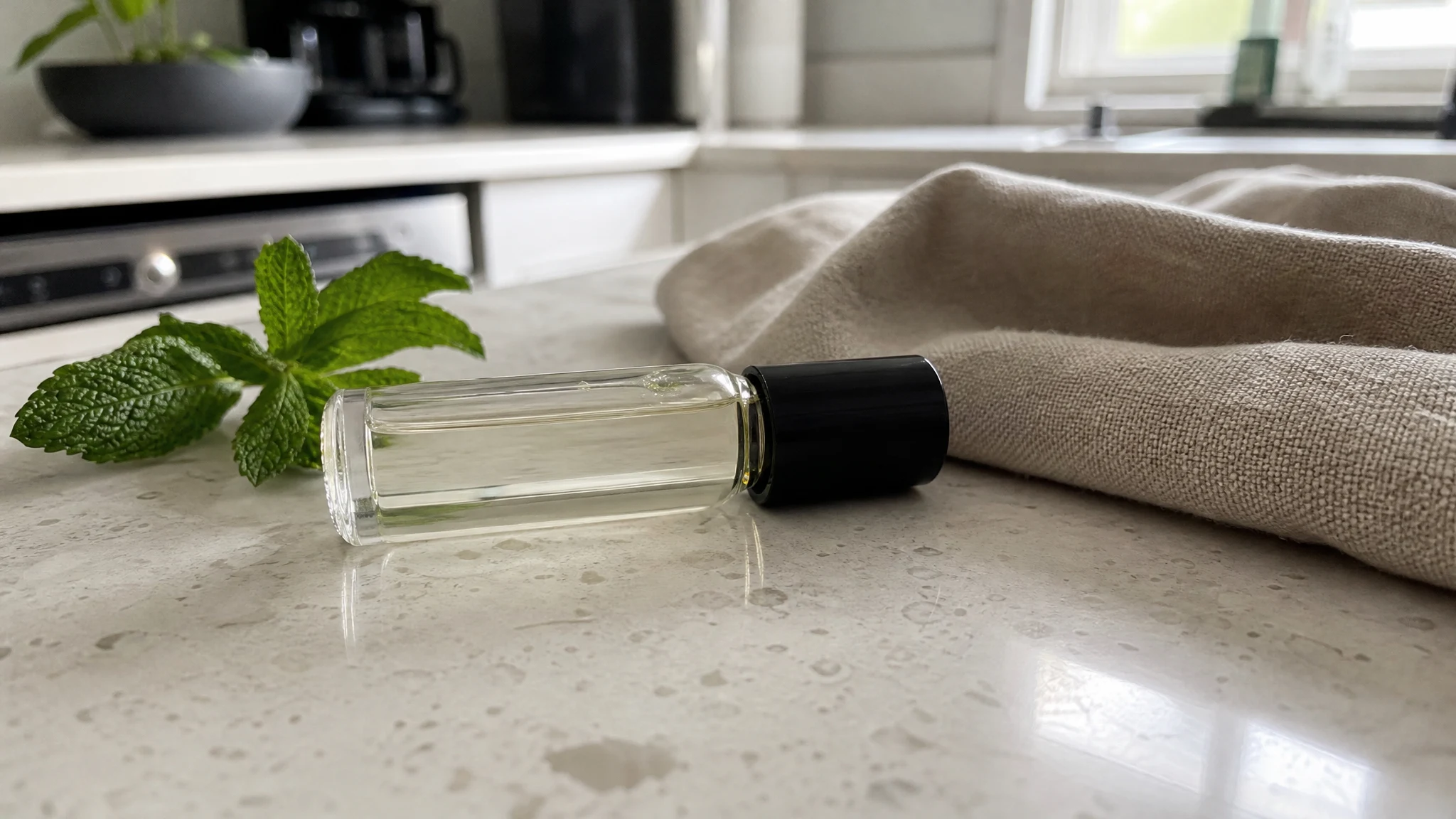
Peppermint Rollerball Recipes: Three Formulas, Limits Shown
A roller bottle makes a strong oil easy to apply, and with menthol that convenience is also the risk: the applicator invites you to roll it on the temple, next to the eye. The three formulations below are worked out by arithmetic for one roller bottle, with the percentage checked against what our shop says and what outside sources report. We have not made or tested any of them, so treat each as a calculation to try in a small batch, not a proven recipe.
Peppermint Essential Oil
Our own Peppermint Essential Oil, in sizes from 0.5 oz to bulk.
From $10.99
Shop Now →Decide first: is a roller the right container?
If the person using it is under school age, skip this article. Our distillation page says not to apply peppermint near the face of an infant or young child, and NCCIH (May 2025) says menthol should not be applied to the face of an infant or small child because it may negatively affect their breathing (NCCIH, 2025). We give no children's dilution; a paediatrician or pharmacist does. If the user is pregnant, has eczema, or has reacted to fragrance before, ask a doctor or dermatologist first. If neither applies, a roller is a fine way to apply a measured blend to forearms, calves or the back of the shoulders. The face, eye area, inside the nose and lips are off the list; where to apply peppermint oil sets out why.
The numbers behind the formulas
We assume a 10 ml roller bottle that you fill to about 9 ml, because the ball fitment needs headspace (a container fact, not a measurement of any particular bottle). We use 20 drops per ml, so a drop is 0.05 ml. Percentage is oil volume divided by total volume, and we ignore the drop volume in the total. The sources are these:
- Our shop copy: dilute to 0.5% to 2% in a carrier oil and patch test first, never take internally, keep away from eyes, children and pets.
- Cosmetic Ingredient Review (2018), secondary through Tisserand and Young: a maximum dermal use level of 5.4% for peppermint oil, based on an assumed 8% menthofuran and 3% pulegone, with limits of 0.5% for menthofuran and 1.2% for pulegone. The same review notes peppermint oil used up to 5% in face and neck leave-on products. Both figures are above 2%, so neither is a reason to go higher (CIR, 2018).
- No verified maximum for cornmint (Mentha arvensis) oil was available to us. The EFSA feed-additive assessment of cornmint oil (2026) says the oil should be considered an irritant to skin and eyes and as a dermal and respiratory sensitiser (EFSA, 2026). That is a hazard statement for a feed additive's handlers, not a skin limit, but it is why we stay at the low end for that oil.
| Drops of oil in 9 ml carrier | Oil, ml | Concentration | Against our 0.5% to 2% copy |
|---|---|---|---|
| 1 | 0.05 | 0.56% | bottom of range |
| 2 | 0.10 | 1.1% | middle |
| 3 | 0.15 | 1.7% | upper part |
| 4 | 0.20 | 2.2% | above our 2% top |
The fourth row is the one to notice. Four drops looks like a modest number, and in a bottle filled to 9 ml it is already over the top of our own range. Dropper size also matters: a dropper that gives 0.07 ml instead of 0.05 ml turns the one-drop bottle into 0.78% (0.07 divided by 9). If you want precision, measure with a 1 ml graduated pipette or oral syringe from a pharmacy or lab-supply shop.
Formulation 1: one oil, the low end
9 ml carrier oil, 1 drop of either of our peppermint oils. About 0.56%. This is where we would start for anyone using peppermint on skin for the first time, and for the cornmint oil in particular. The corresponding share of the 5.4% secondary figure is about 10% (0.56 divided by 5.4).
Formulation 2: one oil, the middle
9 ml carrier oil, 2 drops of the Mentha piperita. About 1.1%, which is a little over a fifth of 5.4% (our arithmetic). This is about the 1% ceiling we recommend for the body. Move to this only after a week of the 0.56% version with no reaction.
Formulation 3: peppermint with one partner oil
9 ml carrier oil, 1 drop peppermint, 2 drops lavender. That is 3 drops of oil in total, 1.7%, of which peppermint is 0.56%. Lavender is not an oil we sell, so buy it from an aromatherapy or craft supplier and ask for the botanical name on the label. NCCIH (February 2025) says topical lavender products may cause allergic skin reactions in some people and reports a few cases of breast-tissue swelling in children who used topical products containing lavender, while noting it is unclear whether lavender caused it (NCCIH, lavender). We could not verify a dermal maximum for lavender, so our rule here is to keep the total oil load at or under 2% and the peppermint share at the low end. The Cosmetic Ingredient Review panel was itself concerned about terpenes and menthol across several botanicals in one product, which could add up to sensitisation (CIR, 2018). That is a reason to resist stacking a third and fourth oil.
We have not recommended eucalyptus, tea tree or citrus oils here. We did not read a hazard page for each, and our shop copy lists them as blend partners without addressing safety. Where a partner oil is not ours, the person to ask is the supplier for its safety data and, for any skin concern, a dermatologist.
Making it, and checking it
- Buy a glass roller bottle with a roller-ball fitment and a carrier oil from a craft or aromatherapy supplier. We sell neither. We have not checked any carrier's own hazards, so pick one you already know you tolerate; the carrier oils article goes through the choices.
- Pour the carrier in first, then the drops, then cap and roll the bottle between your palms. Label it with the date and the drops.
- Patch test the finished blend, not the neat oil: a quarter-sized spot on the inner arm, twice daily for 7 to 10 days, as the American Academy of Dermatology describes (AAD). If you see redness, itching or swelling, wash it off and stop. The AAD page is about skin products in general, so applying it to an oil blend is our inference.
- Wash your hands after rolling. If any gets in an eye, start rinsing with lukewarm water and call the poison line on 1-800-222-1222 (Missouri Poison Center).
- Store the bottle capped, in a cool dark place away from heat and sunlight, the same as our shop says for the oil, and out of reach of children and pets.
For how to turn a different percentage into drops for another container size, see the dilution guide. Our pairing guide covers scent pairings, which is a different question from skin hazard.
If one drop in 9 ml seems too little to bother with, that is the right instinct to keep: with peppermint, the formula that smells faint is the one built correctly.
Peppermint Essential Oil
Peppermint Essential Oil from our own shop, in sizes from 0.5 oz to bulk.
From $10.99
Shop Now →Sources & Further Reading
- NCCIH (NIH), May 2025. Peppermint oil: usefulness and safety. nccih.nih.gov/health/peppermint-oil
- NCCIH (NIH), February 2025. Lavender. nccih.nih.gov/health/lavender
- Cosmetic Ingredient Review, 2018. Safety assessment of Mentha piperita (peppermint)-derived ingredients as used in cosmetics. cir-safety.org/pepper032018rep.pdf
- EFSA FEEDAP Panel, 2026. Safety and efficacy of a feed additive consisting of an essential oil derived from Mentha arvensis L. (cornmint oil). EFSA Journal 24(4):e10039. europepmc.org/MED/41972195
- American Academy of Dermatology. How to test skin care products. aad.org
- Missouri Poison Center. Essential oils. missouripoisoncenter.org