Peppermint Oil on Skin: Menthol, Irritation and Allergy
The cool feeling of peppermint oil on skin is a signal from nerve endings, not a sign the skin is calm, and it is not a measure of how the skin is coping. A skin-care decision with peppermint oil comes down to three questions in order: how much, on what skin, and what happens if you react. This article answers them from the published data, including the awkward parts, and says where we stop and a dermatologist starts.
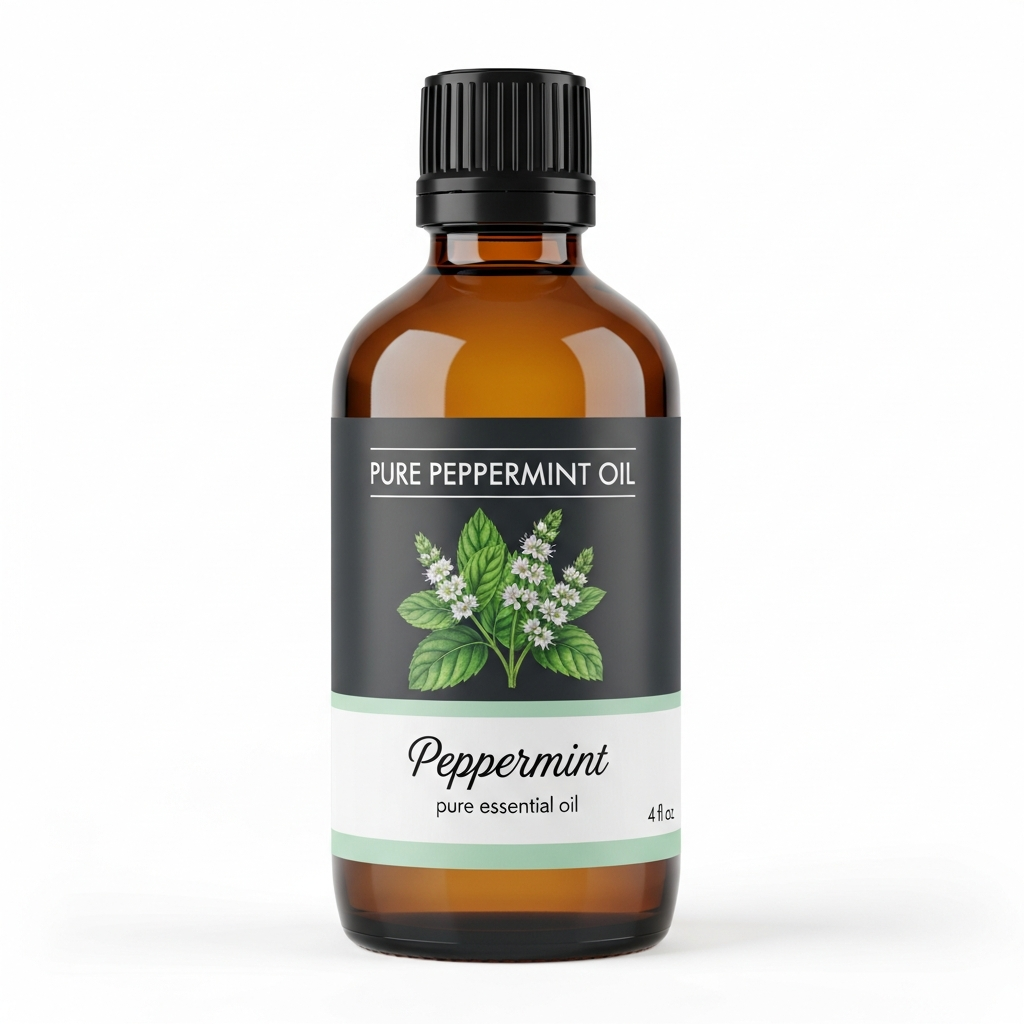
Peppermint Essential Oil
Our own Peppermint Essential Oil, in sizes from 0.5 oz to bulk.
From $10.99
Shop Now →Question one: how much, and why we say the low end
Our oils are sold neat. Our safety copy says to dilute to 0.5% to 2% in a carrier oil and patch test first, and our distillation page says to use far less than you think you need, "one drop where you would use three of something gentler." For face and body we recommend the low end, 0.5% to 1%. That is our stated recommendation, reasoned from menthol being an irritant and peppermint being potent, not a tested result.
The published figures sit above ours. The Cosmetic Ingredient Review panel's 2018 re-review (CIR, 2018) reports that the highest use concentration of peppermint oil in cosmetics rose from 3% in 1997 to 5% in 2017, in face and neck leave-on products, with the oil used in 815 products (432 leave-on, 349 rinse-off, 34 diluted for bath use). It also reports a maximum dermal use level of 5.4% recommended by Tisserand and Young in their 2014 book, which we have read only through CIR. That limit is derived from 8% menthofuran and 3% pulegone content, with limits of 0.5% for menthofuran and 1.2% for pulegone. 2% is 37% of 5.4% (our arithmetic). Both numbers are for Mentha piperita oil. We could not verify a published dermal maximum for the cornmint (Mentha arvensis) oil, and we found no IFRA standard for peppermint oil, menthol, pulegone or menthofuran in the documents we could read, so the arvensis oil gets no figure here beyond our own copy.
The arithmetic of our range, for an ounce of carrier (29.57 ml): 0.5% is about 0.15 ml, or 3 drops at 20 drops per ml; 1% is about 0.3 ml, 6 drops; 2% is about 0.6 ml, 12 drops. Droppers vary, so weighing is better than counting.
Question two: what menthol does to the nerve, and what it does not
Menthol activates a channel in cold-sensing neurons. McKemy, Neuhausser and Julius cloned the menthol-sensitive receptor from trigeminal sensory neurons in 2002 and showed it is also activated by cool-to-cold temperatures (Nature, 2002). The same channel responds to both stimuli, which is why a menthol product feels cold on warm skin. That paper is about the receptor; it does not measure skin temperature or skin condition. Reasoning from it (not from a measurement we have read): a sensation produced by activating a cold receptor does not require the skin to be colder, and it does not show the skin is less inflamed.
A 2023 bibliometric review of topical camphor- and menthol-containing agents (Hoang, Wong and Olympia, Cureus, 2023) identified 15 relevant studies, for pain, upper respiratory symptoms and itch, and judged the evidence suggestive but too limited for firm recommendations. That is the state of the field for isolated menthol and camphor products, which are not neat essential oils.
Acne
We searched Europe PMC on 29 October 2026 for peppermint, Mentha piperita or menthol together with acne. It returned 823 records. We read the titles of the first 25: none was a trial of peppermint oil or menthol applied to acne. They included systematic reviews of essential oils in skin care, material-science papers about dressings and nanofibres, and a laboratory study of essential-oil fibres against acne-associated bacteria. Reading only the first page cannot prove that no such trial exists, but we could not find one, and we do not offer an acne routine. If you have acne, a dermatologist is the person to ask. Neat essential oil near a face already irritated by acne is something we advise against.
Question three: how often skin reacts, according to the data
The same CIR report summarises the dermal data. It is mixed, and we give it as written:
| Test (peppermint oil, via CIR) | Result |
|---|---|
| Human repeated-insult patch test, 20% oil, 104 subjects | Negative for irritation and sensitisation |
| Second such test, 20% oil, 101 subjects | No skin sensitisation observed |
| Maximisation test, 8% oil, 25 healthy men, five 48-hour occlusive patches after a sodium lauryl sulfate pretreatment | No evidence of sensitisation |
| North American Contact Dermatitis Group data, 2% in petrolatum | 0.53% positive reaction prevalence (from a 13,398-patient study in which 71 were tested with the oil) |
| Multicentre study, 73 patients, ICDRG patch-test procedure | No irritant or allergic reactions |
| Case reports in patients with diseased skin | Positive patch test reactions in 8 of 9 |
| Rabbits, 0.05 ml injected into the skin (not applied on the surface), repeated 5 to 10 times | Moderate reactions in 3; severe, with necrosis, in 2 |
So healthy volunteers in controlled tests mostly did not react, even at 8% and 20%, and the positive reactions CIR lists come from patch-test clinic data and from case reports, 8 of 9 in patients with diseased skin. CIR also reports that testing the components of the oil in three patients with allergic contact dermatitis found the allergens were menthol and trace components such as piperitone or pulegone. The panel's overall conclusion is that peppermint oil is "safe in cosmetics in the present practices of use and concentration when formulated to be non-sensitizing." The words "when formulated to be non-sensitizing" carry the weight: it is a conclusion about formulated products, not about an unmeasured drop of neat oil. The rabbit work was injection, so it does not transfer to surface use.
A 2021 review by Sindle and Martin (Int J Womens Dermatol) lists peppermint among popular essential oils and reports rising allergic contact dermatitis from them, urging clinicians to ask about essential-oil use when evaluating suspected contact dermatitis. NCCIH says simply that applying peppermint oil to the skin "can include skin rashes and irritation" (NCCIH, May 2025). Allergy to a plant can be to the whole oil or to one component, and a diluted patch test shows only that you did not react to that mixture, on that spot, that week.
What to do before it touches your face
- Dilute to the low end in a carrier oil you already tolerate (we do not sell carriers; buy from a supplier who publishes its own safety information).
- Patch test the way the AAD describes: a quarter-sized spot on the inner arm or elbow bend, the normal amount, twice a day for 7 to 10 days. If redness, itching or swelling appears, wash it off and do not use it again (AAD).
- Stay away from eyes, broken skin and young children's faces. NCCIH says not to apply peppermint oil to the face of infants or young children. Our own pages say to keep it from eyes and children.
- Know when to stop asking the internet. The AAD says a reaction that is severe and not relieved by cool compresses or petroleum jelly may need a dermatologist, and that if you cannot pin down the culprit ingredient, a board-certified dermatologist can order formal patch testing.
Where our oils fit
Our two oils (Mentha piperita and Mentha arvensis) are sold for fragrance, soap, candle and product making. The certificate of analysis we publish is a refractive index for a piperita sample. The GC-MS report we publish is for the cornmint oil and reports chemical-family totals, with no menthol, pulegone or menthofuran figure. A buyer who needs those numbers for a leave-on skin product should ask in writing and get the document before ordering. We make no claim that either oil treats, soothes or improves skin, and the FDA makes the same distinction: its page says intended use decides whether a product is a cosmetic or a drug (FDA).
More on dilution is in the dilution guide, carrier oils, lips and safety basics.
If you do use peppermint on skin, use less than you think you need, dilute it first, and give the patch test its full ten days.
Peppermint Essential Oil
Peppermint Essential Oil from our own shop, in sizes from 0.5 oz to bulk.
From $10.99
Shop Now →Sources & Further Reading
- Cosmetic Ingredient Review, 2018. Amended Safety Assessment of Mentha piperita (Peppermint)-Derived Ingredients as Used in Cosmetics. cir-safety.org/pepper032018rep.pdf
- McKemy DD, Neuhausser WM, Julius D, 2002. Identification of a cold receptor reveals a general role for TRP channels in thermosensation. Nature 416:52-58. pubmed/11882888
- Hoang D, Wong A, Olympia RP, 2023. Looking back to move forward: the current state of research on the clinical applications of camphor- and menthol-containing agents. Cureus 15:e41426. pubmed/37546095
- Sindle A, Martin K, 2021. Art of prevention: essential oils, natural products not necessarily safe. Int J Womens Dermatol 7:304-308. pubmed/34222588
- NCCIH (NIH), May 2025. Peppermint Oil: Usefulness and Safety. nccih.nih.gov/health/peppermint-oil
- American Academy of Dermatology. How to test skin care products. aad.org/public/everyday-care
- US FDA. Is it a cosmetic, a drug, or both? (Or is it soap?) fda.gov/cosmetics
- Europe PMC literature search run 29 October 2026 (peppermint, Mentha piperita or menthol with acne; 823 records, first 25 titles read). europepmc.org