Peppermint Oil and Lips: Why the Tingle Is Not a Plumper
The tingle that peppermint gives a lip balm is a sensation, not a sign that anything is being improved, and lips are the one place where we would rather you did not experiment with a bottle of neat essential oil. Our oils are sold undiluted and labelled not for internal use. A lip product sits on the edge of the mouth, and some of it will be licked or swallowed (we found no verified figure for how much), so the usual dilution advice does not carry over to lips without a formulator in the loop.
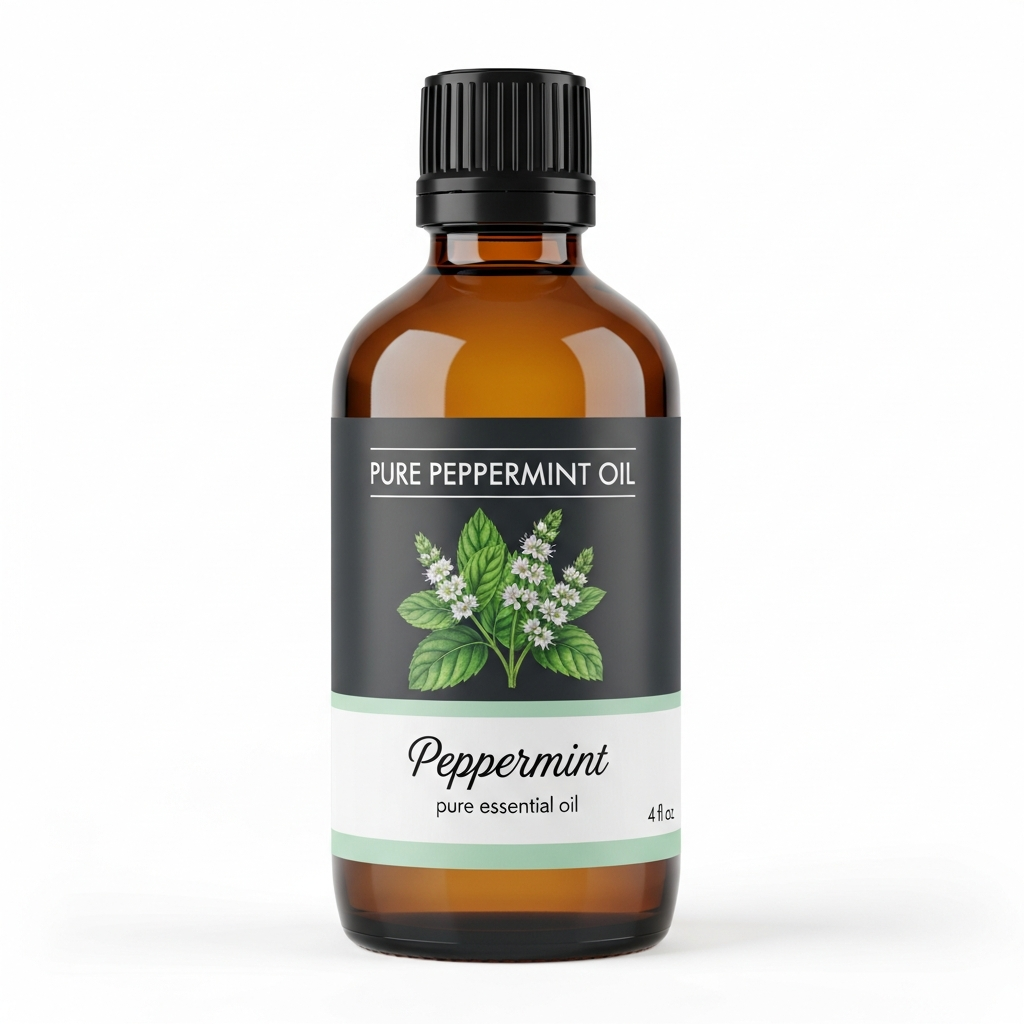
Peppermint Essential Oil
Our own Peppermint Essential Oil, in sizes from 0.5 oz to bulk.
From $10.99
Shop Now →What the tingle is
Menthol activates a cold-sensing ion channel called TRPM8. Peier and colleagues, 2002 cloned the channel and reported that cells carrying it respond to both cold and menthol. The abstract does not describe lips or any measurement of tissue temperature, so the following is reasoning from that mechanism: a menthol-rich oil can make nerve endings report cold when nothing has cooled. The sensation is real to the person feeling it, and it is also the reason a mint balm can feel like it is "doing something" while telling you nothing about the skin underneath.
Our two oils are both described by the shop as menthol-forward: the Mentha piperita page says "naturally rich in menthol" and the Mentha arvensis (cornmint) page says "a strong menthol backbone". Neither product page gives a menthol figure, and the published GC-MS report is for the cornmint oil only and gives chemical-family totals, so this article makes no claim about how much menthol is in a given bottle.
Why a lip plumper is not a plumper
Products sold as lip plumpers commonly rely on a warming or cooling irritant. The one clinical report we read, a 2018 open-label trial of a lip plumper containing capsaicin, cinnamon and menthol (indexed as PubMed 30235388), says that a tingling or heat sensation was expected and observed because of those ingredients. That is all we could verify from it through a search summary: we did not read its full text, so we cannot give its sample size or its measured effect. We found no dermatology-society statement on how plumper irritants work, and we did not find a published peppermint oil or menthol concentration limit for lip products. Take any claim that a mint oil "plumps" lips as unsupported until you see a controlled measurement of lip volume.
The regulatory side matters as much as the biology. The FDA, undated page says whether a product is a cosmetic or a drug "is determined by a product's intended use", and that intent is shown by labelling, advertising and promotional claims. A balm sold to change how lips look sits in cosmetic territory. A balm marketed for a medical purpose on the lips makes a drug claim. We make no such claim for our oils, and a lip product built from them would carry the same limit.
What goes wrong on lips specifically
The documented problem is allergy, not the tingle. Tran, Pratt and DeKoven, 2010, writing in Dermatitis, described four patients with allergic contact cheilitis (an inflamed, swollen, scaly reaction of the lips) from a peppermint-containing lip balm. The balm also listed propolis, lanolin, coconut oil, almond oil and vitamin E. The authors patch tested the patients with the standard North American series, an expanded flavouring series, and the patients' own products, and concluded that peppermint oil was the most likely cause. They also noted that peppermint oil causes this reaction less often than balsam of Peru or nickel sulfate, and expected more cases as peppermint lip balms become more common. Four patients and one product category is a case series: it shows the reaction is possible, not how often it happens.
DermNet describes lipsticks and lip-care products as "the commonest cause of allergic contact cheilitis in women", names fragrances and flavourings among the culprits, and lists peppermint oil among the flavourings. Its acute picture is swelling and small blisters within minutes of contact, and its chronic picture is redness, scaling or dryness and itch that can last days to months while the exposure continues. Its advice is to stop the product, to have the person's own products patch tested (some people react only to those), and to see a dermatologist for any skin concern.
The NCCIH, May 2025 page adds that skin application of peppermint oil can cause rashes and irritation, and that menthol "should not be applied to the face of an infant or young child" because it may negatively affect breathing. Our own distillation page says the same in plainer words. The practical consequence for lips: nothing mint-scented goes on or near a young child's mouth, and a balm that has been on an adult's lips should not be what a child kisses or sucks.
The arithmetic that makes lip work a formulator's job
We do not give a lip percentage because no authority figure for lips was verified, and our general copy (0.5% to 2% in a carrier oil with a patch test first) is skin guidance, not a lip rating. What we can show is why the numbers are awkward by hand. Take a 5 ml lip balm, roughly a standard tube. At about 20 drops to the millilitre, which varies by dropper, one drop is about 0.05 ml, and 0.05 ml in 5 ml is 1%. Half a drop is not a thing a dropper delivers, so the finest dose you can reach by counting drops in a tube that size is already at the middle of our own range, with no allowance for how unevenly it will mix into a wax and butter base. Making it more dilute means weighing on a milligram scale or making a much larger batch, and then you have a product that someone will ingest in small amounts every day.
That is the point at which a cosmetic chemist or product-safety assessor, not a blog post, should be deciding the concentration, the preservative need and the label.
Our position
Our shop copy lists lip balms among the uses for both oils. Our position for readers asking about this page is narrower: we do not publish a lip recipe or percentage, we have not made or tested a lip balm, and we would not hand a neat oil to anyone for direct use on lips. If you make lip products to sell, the wax, butters, carrier oils and any preservative come from a craft or cosmetic supply shop, each with its own data sheet, and the finished product needs a safety assessment. Wholesale buyers can read about sample bottles and custom formulations, and a buyer who needs species-matched analysis for a formulation should ask for it in writing before ordering.
When to see someone
Stop a lip product and see a doctor or dermatologist if the lips swell, blister or crack, if a reaction is not clearing after stopping, or if the same lips keep reacting. Ask for patch testing of your own balm and lipstick, as DermNet advises. If a child has swallowed any essential oil or product containing it, call Poison Help at 1-800-222-1222.
More on diluting and patch testing is in peppermint oil safety basics, how to dilute peppermint oil, peppermint oil and skin, and why a bottle of essential oil is not for swallowing.
A tingle on the lips tells you a nerve channel was triggered, and nothing more. If you want that sensation in a product, the decision belongs with someone qualified to assess a lip-contact formulation.
Peppermint Essential Oil
Peppermint Essential Oil from our own shop, in sizes from 0.5 oz to bulk.
From $10.99
Shop Now →Sources & Further Reading
- U.S. Food and Drug Administration. Is It a Cosmetic, a Drug, or Both? (Or Is It Soap?). fda.gov/cosmetics
- Tran A, Pratt M, DeKoven J, 2010. Acute allergic contact dermatitis of the lips from peppermint oil in a lip balm. Dermatitis 21(2):111-115. pubmed/20233551
- DermNet. Contact reactions to lipsticks and other lipcare products. dermnetnz.org
- Peier AM et al, 2002. A TRP channel that senses cold stimuli and menthol. Cell 108(5):705-715. pubmed/11893340
- National Center for Complementary and Integrative Health, May 2025. Peppermint Oil: Usefulness and Safety. nccih.nih.gov
- Single-site open-label trial of a capsaicin, cinnamon and menthol lip plumper, 2018 (abstract seen via search only). pubmed/30235388