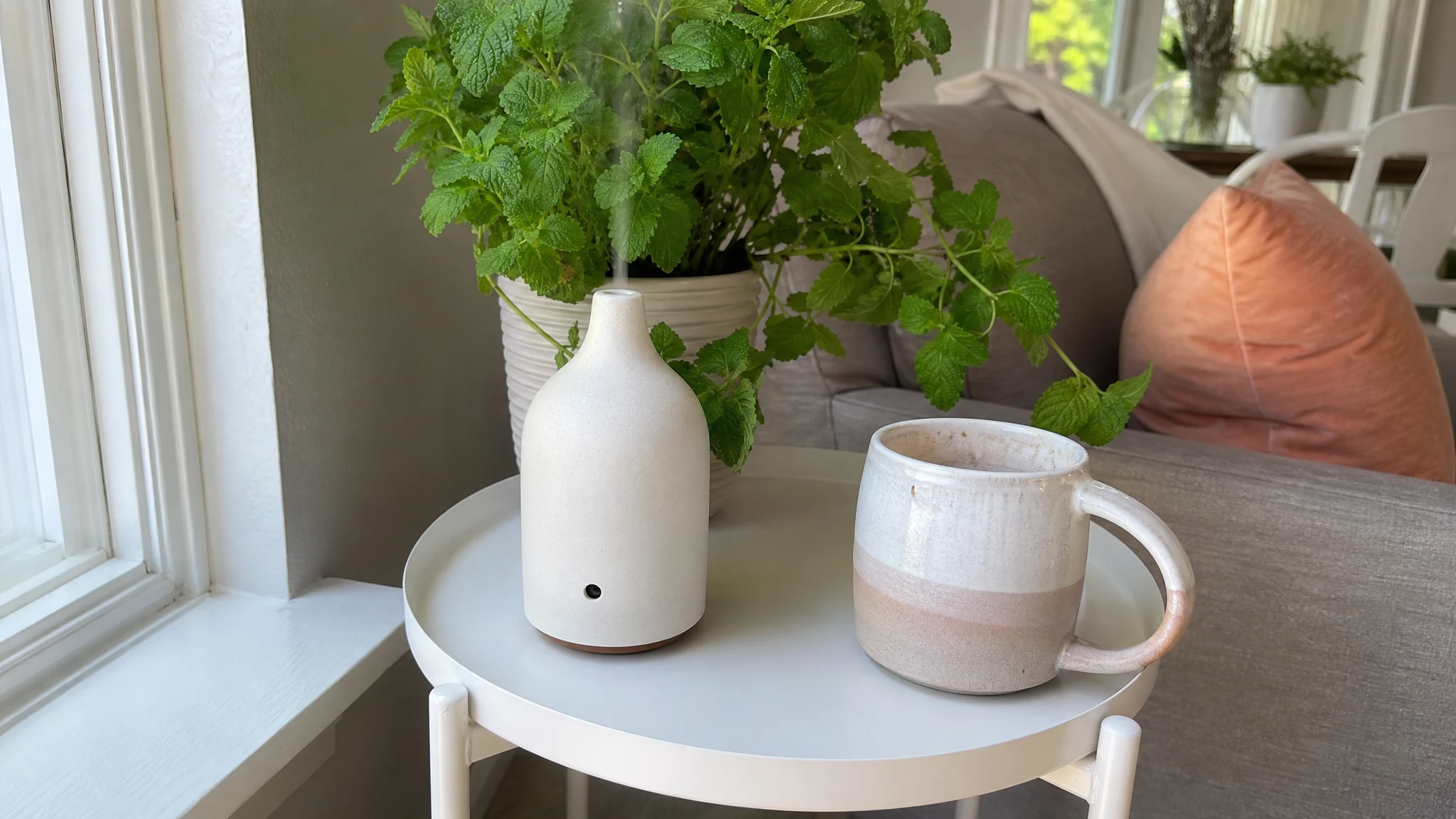
How Many Drops of Peppermint Oil in a Diffuser
For a diffuser with a tank of about 100 ml, the two manufacturer guides we could read say 2 to 4 drops of oil, not 10. Peppermint is a potent oil, so the low end of any manufacturer's range is where we would start. The rest of this article is the arithmetic behind that, a table you can scale to your own tank, and the limits that have nothing to do with drop counts: children, cats and air.
Peppermint Essential Oil
Our own Peppermint Essential Oil, in sizes from 0.5 oz to bulk.
From $10.99
Shop Now →What two manuals actually say
| Source | Tank | Drops stated | Run time or coverage stated |
|---|---|---|---|
| Muji, ultrasonic aroma diffuser product page | about 100 ml | 2 to 4 | timers of 30, 60, 120 and 180 minutes; rated for 100 to 130 sq ft |
| Aroma Scents ultrasonic diffuser manual (part 517215) | 110 ml | 2 to 3, marked optional | up to 10 hours intermittent, up to 5 hours continuous; up to 200 sq ft |
Both give the figure for one fill of water, and neither names peppermint or says the count changes with the oil. The Aroma Scents manual also says to keep the unit out of reach of children and pets, to use only tap or bottled water with "a few drops" of oil, and to unplug before filling or cleaning (Muji Canada; Aroma Scents manual). Our own shop copy says to add "a few drops", which is consistent but not a number. We have not tested any drop count in a diffuser, and we are not going to publish one as if we had.
Robert Tisserand, replying to a reader on the Tisserand Institute's page on children and inhalation in March 2020, said that dilution rates do not apply to diffusion, which depends on the amount of oil and the type of diffuser, and called 2 to 3 drops over several hours a reasonable guide. That is a comment on a web page from a recognised author, not a trial, but it lines up with the two manuals (Tisserand Institute).
The arithmetic, in millilitres
We use 20 drops per ml (droppers vary), so one drop is 0.05 ml. The Cosmetic Ingredient Review lists the USP specific gravity for peppermint oil as 0.896 to 0.908, so one drop weighs roughly 0.045 g (0.05 ml times about 0.9). That is general literature for peppermint oil, not a figure we publish for either of our oils (CIR, 2018).
| Water in tank | 2 drops | 3 drops | 4 drops |
|---|---|---|---|
| 100 ml | 0.1 ml oil, about 0.09 g | 0.15 ml, about 0.14 g | 0.2 ml, about 0.18 g |
| Oil as a share of the water by volume | 0.1% | 0.15% | 0.2% |
Two practical conclusions follow. First, a 1 oz bottle is 29.57 ml, about 590 drops, so at 3 drops a session it holds roughly 197 sessions; the oil is not what limits you, and there is no saving in under-filling. Second, if your tank is 300 ml, scaling the manuals' per-100-ml figure straight up gives 6 to 12 drops. No manual we read says oil scales linearly with tank size, so treat that as an upper bound from reasoning and start with the low figure for a bigger tank too. Check your own manual first: it overrides everything here.
Per hour of running, the same sources work out as follows. Muji's 2 to 4 drops over a maximum 3-hour timer is 0.7 to 1.3 drops an hour. Aroma Scents' 2 to 3 drops over up to 5 hours continuous is 0.4 to 0.6 an hour. Tisserand's 2 to 3 drops "over several hours" is the same order of magnitude.
What goes into the air
Diffused oil goes into the air everyone in the room breathes. Kim and Kwon (2026) ran a commercial diffuser in an office for two weeks and measured terpenes. Emissions peaked right after start-up and tapered. In the first 2 hours limonene rose from 1.8 to 5.8 micrograms per cubic metre, alpha-pinene from 0.17 to 2.2 and beta-pinene from 0.12 to 1.7. One unidentified compound spiked far above background, and the authors say it may be a sampling artefact or a reaction product. The abstract does not say which oil was used, so it is not peppermint data (Kim and Kwon, 2026). A 2020 review by Angulo Milhem and colleagues concluded that essential-oil products are a major indoor source of terpenes, that terpenes can deposit on surfaces, and that they can react with indoor oxidants to form secondary pollutants including formaldehyde and secondary organic aerosols (Angulo Milhem et al., 2020).
Those studies do not tell you what any particular diffusing schedule does in your home. They are the reason for our reasoning-based advice: run it intermittently rather than all day, crack a window or run the room's fan, and stop if anyone in the room coughs or develops a headache. Peppermint specifically is high in menthol, and the sources above did not measure it.
Who should not be in the room
- Infants and small children. NCCIH (May 2025) says menthol should not be inhaled by or applied to the face of an infant or small child because it may negatively affect breathing. Hana Tisserand wrote in 2022 that the peppermint caution is because it can potentially slow breathing in small children, with any effect seen right away and ending when diffusion stops. We give no age-based diffuser instruction; ask a paediatrician or pharmacist. See the children's article.
- Cats and other pets. The ASPCA's page for mint lists it as toxic to dogs, cats and horses, with the toxic principle given as essential oils. Its 2020 news article says cats are especially sensitive to essential oils and advises against using them in areas where pets have access unless pets are supervised or a veterinarian has approved. Call the ASPCA line on (888) 426-4435 or your vet if a pet shows signs (ASPCA, mint; ASPCA, 2020). Our cats guide goes further.
- Anyone who has reacted to it. Stop diffusing and ask a doctor or pharmacist.
Which of our oils, and what we will not say
We sell two: a Mentha piperita described as crisp, cool and minty with a faint candy-like sweetness, and a Mentha arvensis (cornmint) described as bold and cooling with a strong menthol backbone. Both are sold neat for diffusers, among other uses. The manual figures above are the same whichever you choose, but the cornmint copy is the more intense, so if you pick it, begin at 1 or 2 drops. We make no claim that diffusing either one does anything for focus, congestion or sleep; for what the studies say, see the focus article and the congestion article.
Start with 2 drops in a 100 ml tank, run it for an hour with the door open, and add a drop only if you cannot smell it from across the room.
Peppermint Essential Oil
Peppermint Essential Oil from our own shop, in sizes from 0.5 oz to bulk.
From $10.99
Shop Now →Sources & Further Reading
- Muji Canada. Ultrasonic aroma diffuser 100 ml (product page). muji.ca/products/small-aroma-diffuser
- Aroma Scents. Ultrasonic essential oil diffuser instruction manual, part 517215. AromaScents_DiffuserManual.pdf
- Tisserand Institute. Kids and inhalation safety (comments, 2019-2022). tisserandinstitute.org
- Cosmetic Ingredient Review, 2018. Safety assessment of Mentha piperita (peppermint)-derived ingredients as used in cosmetics. cir-safety.org/pepper032018rep.pdf
- Kim PG, Kwon JH, 2026. Time-dependent emission characteristics of terpenes from an essential oil diffuser. Journal of Environmental Science and Health Part A 61(4):263-271. europepmc.org/MED/41805452
- Angulo Milhem S, Verriele M, Nicolas M, Thevenet F, 2020. Does the ubiquitous use of essential oil-based products promote indoor air quality? Environmental Science and Pollution Research 27:14365-14411. europepmc.org/MED/32162221
- NCCIH (NIH), May 2025. Peppermint oil: usefulness and safety. nccih.nih.gov/health/peppermint-oil
- ASPCA. Mint (Mentha sp.) and Pet poisons: be mindful of these household products (4 June 2020). aspca.org