
Peppermint Oil for Focus: What Two Small Studies Measured
A smell can change how alert you feel for a few minutes. The small studies behind "peppermint for focus" are more specific, and more limited, than the claims built on them. Here is what was measured, in whom, and what was not, so you can decide whether a bottle on the desk is worth buying for the scent alone.
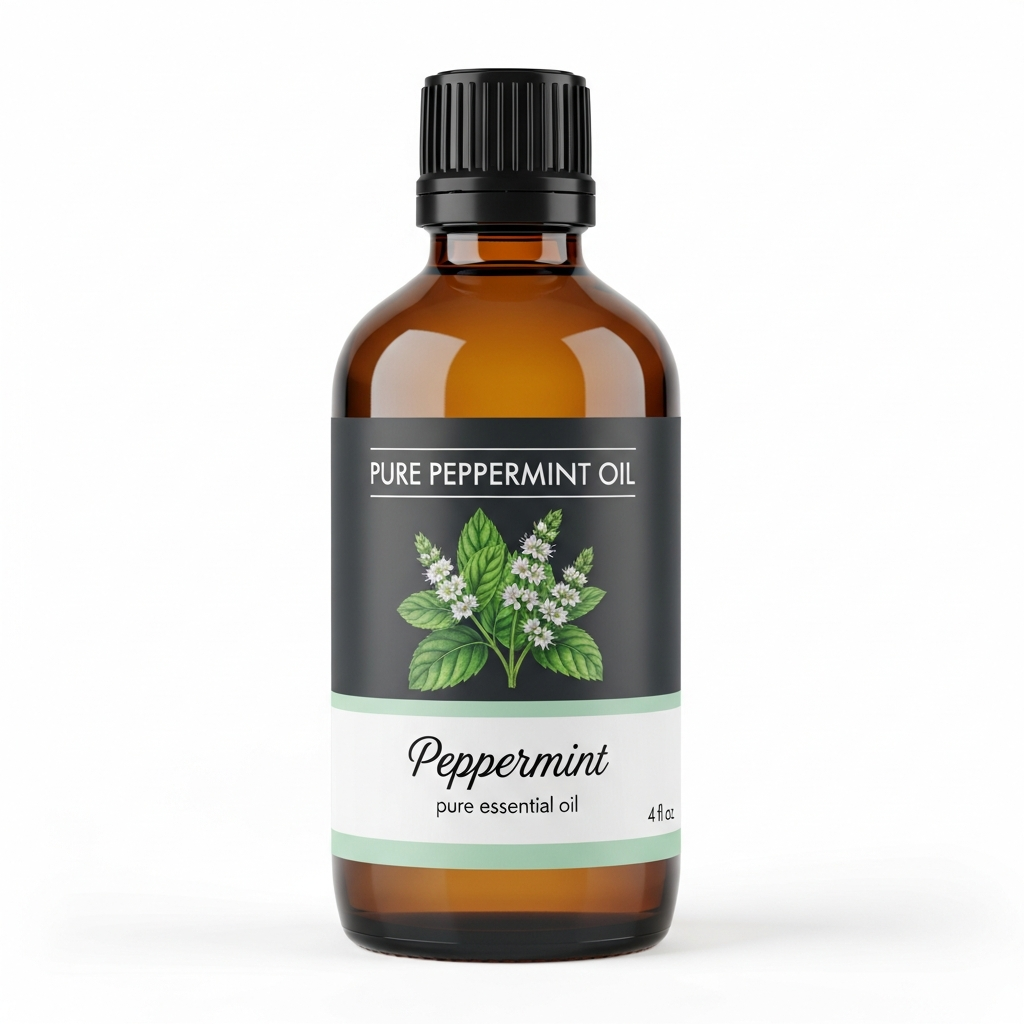
Peppermint Essential Oil
Our own Peppermint Essential Oil, in sizes from 0.5 oz to bulk.
From $10.99
Shop Now →Study one: 144 volunteers, three rooms
Moss, Hewitt, Moss and Wesnes (International Journal of Neuroscience, 2008) randomly assigned 144 healthy volunteers to one of three conditions: ylang-ylang aroma, peppermint aroma, or no aroma. Cognition was tested with the Cognitive Drug Research computerised battery, and mood was rated before and after testing. Peppermint was associated with better memory and higher alertness, while ylang-ylang impaired memory, slowed processing speed and lowered alertness while raising calmness. The authors concluded that aromas can have distinct effects on both subjective and objective measures (Moss et al., 2008).
The abstract does not give the group sizes, but an even split would be 48 people per condition (144 divided by 3, our arithmetic). That is small for a battery with many outcome measures, and we read only the abstract, which does not report effect sizes or say how the result was adjusted for testing many measures. The no-aroma group is also the weak point: a person in the peppermint room knows they are smelling peppermint, so the trial cannot be blinded in the usual sense. That is our reasoning from the design described, not a finding of the paper, but it is why the "alertness" rating in particular should be read as partly expectation.
Study two: typing, filing and memorising
Barker and colleagues (Perceptual and Motor Skills, 2003) had each participant complete the protocol twice, once with peppermint odour present and once without. With the odour, typing gross speed, net speed and accuracy were significantly better, and so was alphabetisation. Typing duration and memorisation showed no significant effect. The authors suggested peppermint odour may heighten attention. The abstract does not state the number of participants (Barker et al., 2003).
Put the two papers side by side and they disagree on memory. Moss found a memory benefit in 2008. Barker found no effect on memorisation in 2003. Different tasks, different batteries and different delivery of the aroma could explain it, and we cannot tell which from the abstracts. That is the honest picture: a handful of small studies, mixed on the cognitive domain, with clerical speed the clearest signal.
Why "effective" in a review does not settle it
A 2024 scoping review of olfactory interventions for fatigue at work (Jiang, Muthusamy and Fang, Frontiers in Public Health) covered 28 studies and concluded that olfactory intervention "is effective and promising for enhancing alertness" (Jiang et al., 2024). Scoping reviews map what exists across many scents and settings; the abstract does not say it weighed each study's blinding or bias, and it is not specific to peppermint. So it supports "worth studying", not "this works for you".
The U.S. National Center for Complementary and Integrative Health is plainer. On aromatherapy generally it says that, for insomnia, "we don't know whether it's helpful because little rigorous research has been done," and describes a study in which lemon scent improved mood while neither lemon nor lavender affected stress indicators such as immune markers (NCCIH, updated January 2020). That page is about a different outcome and different scents, but the pattern carries: a scent can shift how you rate your mood without shifting a physiological marker.
What we would do with this
| Claim | Support in the sources above | Our position |
|---|---|---|
| Peppermint odour is a stimulant | None: studies measured scent exposure and tasks, not a drug effect | It is a scent |
| It improves typing and clerical speed | One within-subjects study, n not in abstract (2003) | One study; we found no replication to cite |
| It improves memory | One 144-person study (2008); a second study found no effect on memorisation | Mixed |
| It works for fatigue | Scoping review of many scents; not peppermint specific | No claim from us |
Our position is practical. If you like the smell, a few drops in a diffuser at the start of a work block can become a cue, a habit tied to a place and time. That is a plausible behavioural reason to use it, though we have no study on it to cite, so treat it as our reasoning and not a result. How many drops is arithmetic you can do from the diffuser's manual: see how many drops belong in a diffuser. For the lighter-touch uses, our morning routine post covers a different angle.
We sell two peppermint oils, one Mentha piperita and one Mentha arvensis (cornmint), and the shop copy calls them crisp and cool and bold and cooling respectively. The studies above used peppermint odour without naming the supplier or species in the abstracts, so none of this tells you that either of our oils does anything to your concentration. Keep it out of the room of infants and small children (menthol can affect their breathing, as our children's article reports) and out of the room of a cat; see the cats guide.
If you want to find out for yourself
Barker's design is the one a person can copy, because each participant served as their own control. Reasoning from that design: pick one repeatable task you do daily (a typing test, a fixed set of filing or data-entry items), do it at the same hour, and alternate days with and without the scent over, say, four weeks. Write down the score and how long you took. Day-to-day swings in sleep and caffeine will be large compared with any small scent effect, so ten days of data will not distinguish them, and you cannot blind yourself to the smell. Treat a clear gap as a hint and no gap as an answer. This is a suggestion, not a validated protocol.
When tiredness is not a scent problem
The NHS advises seeing a GP if you have been tired for a few weeks and are not sure why, if tiredness affects your daily life, or if it comes with other symptoms such as weight loss or mood changes, and it advises seeing a GP rather than guessing the cause yourself (NHS, tiredness and fatigue). A scent will not tell you why you are tired; a clinician can.
If the smell of peppermint at your desk makes the day nicer, that is a fair reason to buy it, and a low-cost one to test yourself with a diffuser. It is not a reason to expect a measurable change in your work.
Peppermint Essential Oil
Peppermint Essential Oil from our own shop, in sizes from 0.5 oz to bulk.
From $10.99
Shop Now →Sources & Further Reading
- Moss M, Hewitt S, Moss L, Wesnes K, 2008. Modulation of cognitive performance and mood by aromas of peppermint and ylang-ylang. International Journal of Neuroscience 118:59-77. europepmc.org/MED/18041606
- Barker S, Grayhem P, Koon J, Perkins J, Whalen A, Raudenbush B, 2003. Improved performance on clerical tasks associated with administration of peppermint odor. Perceptual and Motor Skills 97:1007-1010. europepmc.org/MED/14738372
- Jiang X, Muthusamy K, Fang X, 2024. A scoping review of olfactory interventions for fatigue relief: addressing occupational health hazards. Frontiers in Public Health. europepmc.org/MED/39005987
- NCCIH (NIH), January 2020. Aromatherapy and essential oils. nccih.nih.gov/health/aromatherapy
- NHS. Tiredness and fatigue. nhs.uk/symptoms/tiredness-and-fatigue