
Peppermint Oil and a Blocked Nose: Cooling Is Not Clearing
The cooling you feel when you breathe in menthol is a nerve signal, not a wider nasal passage. Measurements taken in 1983 and 1988 found that menthol vapour changed how airflow felt without changing how much resistance the nose actually offered. That gap is the whole story of peppermint oil and a blocked nose, and it is why we sell our peppermint oils for scent and not as anything for congestion.
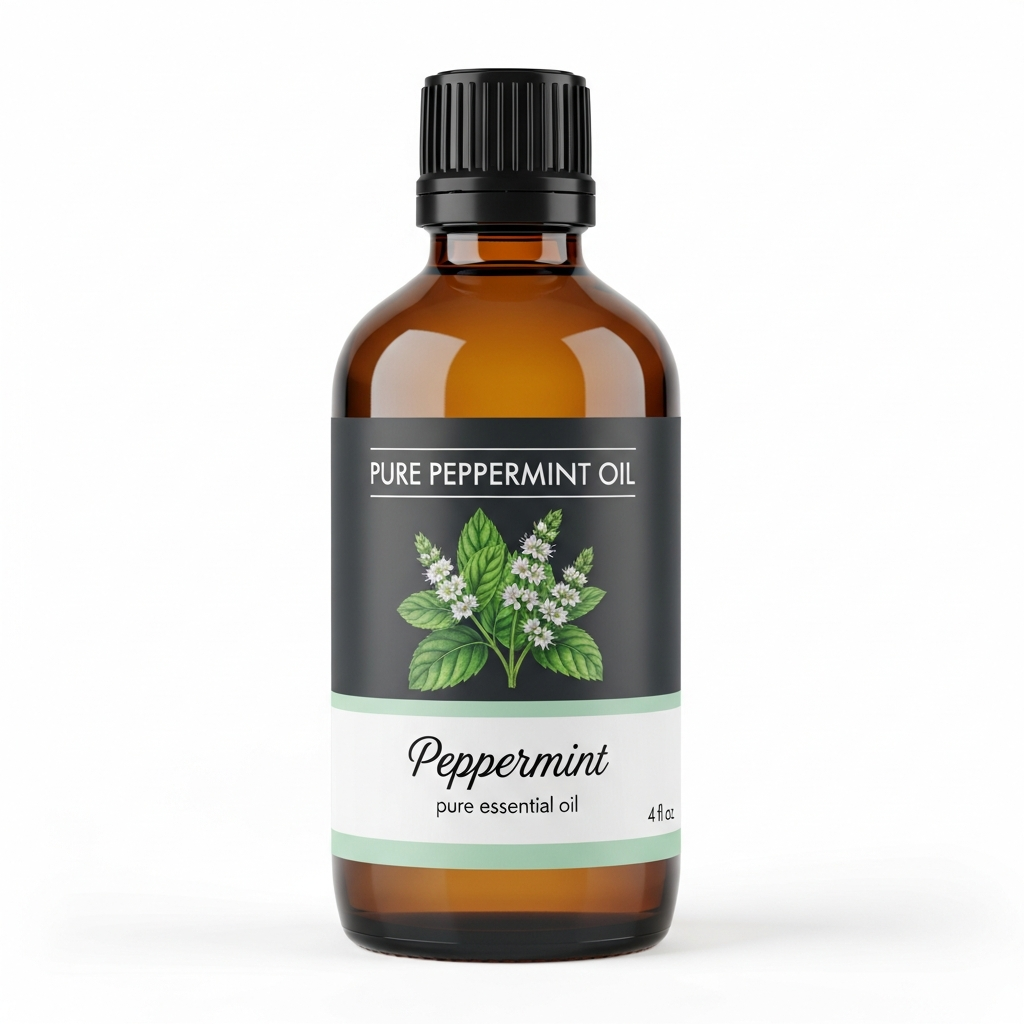
Peppermint Essential Oil
Our own Peppermint Essential Oil, in sizes from 0.5 oz to bulk.
From $10.99
Shop Now →What the measurements showed
Three small laboratory papers are the evidence behind the idea, so here is what each did and did not show.
- Burrow, Eccles and Jones, 1983. Volunteers breathed camphor, eucalyptus or menthol vapour for five minutes, and the team compared the effect with exercise. Objective nasal resistance to airflow did not change with any of the three vapours. Most subjects nonetheless reported a cold sensation and easier airflow. Exercise did lower resistance but produced no such sensation. The authors concluded the vapours most likely stimulate cold receptors in the nose (Burrow et al., Acta Oto-Laryngologica, 1983).
- Eccles and colleagues, 1988 (two papers). In one, 40 subjects inhaled L-menthol, D-isomenthol or D-neomenthol. Only L-menthol raised the sensation of airflow, even though the other two are structurally close and also smell of peppermint. In the other paper, only L-menthol raised the sense of airway patency compared with a vanilla control, and none of the substances changed objective nasal resistance (Eccles et al., Clin Otolaryngol, 1988; Eccles et al., J Laryngol Otol, 1988).
Three limits matter. These trials used menthol vapour or isolated menthol, not peppermint essential oil, so applying them to a bottle of oil is an inference. The abstracts do not report that the studies were done on people with colds or blocked noses. And the outcome that moved was perception, which is real to the person feeling it but is not the same as a clearer passage.
Why that matters if you are actually blocked
Nasal resistance is the physical thing that makes a nose blocked, and the 1983 and 1988 measurements found menthol did not change it. So the sensible reading is: menthol may make congestion feel less oppressive for a few minutes, and it will not tell you whether you have improved. If you judge your cold by how open your nose feels right after a menthol vapour, you can be misled in either direction.
The same caution applies to steam, which many people pair with peppermint. The Cochrane review of heated, humidified air for the common cold (Singh and colleagues, 2017) found six trials with 387 participants. A fixed-effect analysis favoured heated, humidified air on symptom outcomes (odds ratio 0.30, 95% CI 0.16 to 0.56, two studies, 149 participants), a random-effects analysis found no significant difference (OR 0.22, 95% CI 0.03 to 1.95), and the review graded the evidence low quality and concluded it showed neither benefit nor harm (Singh et al., Cochrane, 2017). Reported adverse events were minor, mainly nasal discomfort or irritation. The NHS common-cold page says to breathe in steam from a hot shower for a blocked nose, and warns against letting children breathe steam from a bowl of hot water because of the risk of scalding (NHS, common cold). We would add nothing to the hot water: the studies above do not test peppermint oil in steam, and we have no basis to recommend it.
Where our oil stands
| Question | What the sources say | What we say |
|---|---|---|
| Does menthol change nasal resistance? | No change in 1983 and 1988 measurements | We do not claim it clears anything |
| Does it change the feeling of airflow? | Yes, for L-menthol, in small lab studies | The cool sensation is part of how the shop describes the scent; we do not sell it as a decongestant |
| Is peppermint oil the material those studies used? | No, menthol vapour or isolated menthol | Treat the link as inference |
| Is inhaled peppermint oil acceptable for everyone? | NCCIH, May 2025: calls it possibly safe when inhaled as aromatherapy; warns against inhaling it or applying it to the face of an infant or small child | Our shop sells it for diffusers and the like, with no medical claims |
We sell two peppermint oils, a Mentha piperita and a Mentha arvensis (cornmint), as neat material for fragrance and home use. Our distillation page says to use far less than you think you need, and the shop copy says not to take it internally and to keep it from eyes, children and pets. If you diffuse either one, how many drops belong in a diffuser is a separate arithmetic question we work through in our diffuser drops guide.
Children: a hard stop
Our distillation page says not to apply the oil near the face of an infant or young child, where concentrated menthol can affect breathing. That matches the National Center for Complementary and Integrative Health (May 2025): menthol "should not be inhaled by or applied to the face of an infant or small child because it may negatively affect their breathing" (NCCIH, 2025). Hana Tisserand wrote in 2022 that the peppermint caution is because it can potentially slow breathing in small children, with any effect showing up right away and not persisting after diffusion ends (Tisserand Institute). That is a comment on a web page by an authority in the field, not a trial. We give no age-based dilution or diffuser instruction for children. Ask a paediatrician or pharmacist, and see our children's article for what authorities say.
When a blocked nose needs a person, not a bottle
The NHS says to see a GP if you have a high temperature for more than 3 days, if cold symptoms have not improved after 10 days, if you feel short of breath or have chest pain, or if you are worried about your child's symptoms. It also notes that decongestant nasal sprays can make symptoms worse if used for more than a week, and that decongestants should not be used by children under 6 (NHS, common cold). A pharmacist can advise on those products. For a nose that is blocked for weeks, one-sided, or associated with facial pain, the person to see is a doctor, not a diffuser. Related reading: peppermint oil and headaches and safety basics.
If you buy our oil, buy it for what it smells like: crisp, cool and minty, the way the shop describes it. Do not buy it expecting a clear nose; a pharmacist or GP is the right call for that, and the NHS page above lists what they can offer.
Peppermint Essential Oil
Peppermint Essential Oil from our own shop, in sizes from 0.5 oz to bulk.
From $10.99
Shop Now →Sources & Further Reading
- Burrow A, Eccles R, Jones AS, 1983. The effects of camphor, eucalyptus and menthol vapour on nasal resistance to airflow and nasal sensation. Acta Oto-Laryngologica 96:157-161. europepmc.org/MED/6613544
- Eccles R, Griffiths DH, Newton CG, Tolley NS, 1988. The effects of menthol isomers on nasal sensation of airflow. Clinical Otolaryngology 13:25-29. europepmc.org/MED/3370851
- Eccles R, Griffiths DH, Newton CG, Tolley NS, 1988. The effects of D and L isomers of menthol upon nasal sensation of airflow. Journal of Laryngology and Otology 102:506-508. europepmc.org/MED/3397650
- Singh M, Singh M, Jaiswal N, Chauhan A, 2017. Heated, humidified air for the common cold. Cochrane Database of Systematic Reviews. europepmc.org/MED/28849871
- NHS. Common cold. nhs.uk/conditions/common-cold
- NCCIH (NIH), May 2025. Peppermint oil: usefulness and safety. nccih.nih.gov/health/peppermint-oil
- Tisserand Institute. Kids and inhalation safety (comments by R. and H. Tisserand, 2019-2022). tisserandinstitute.org