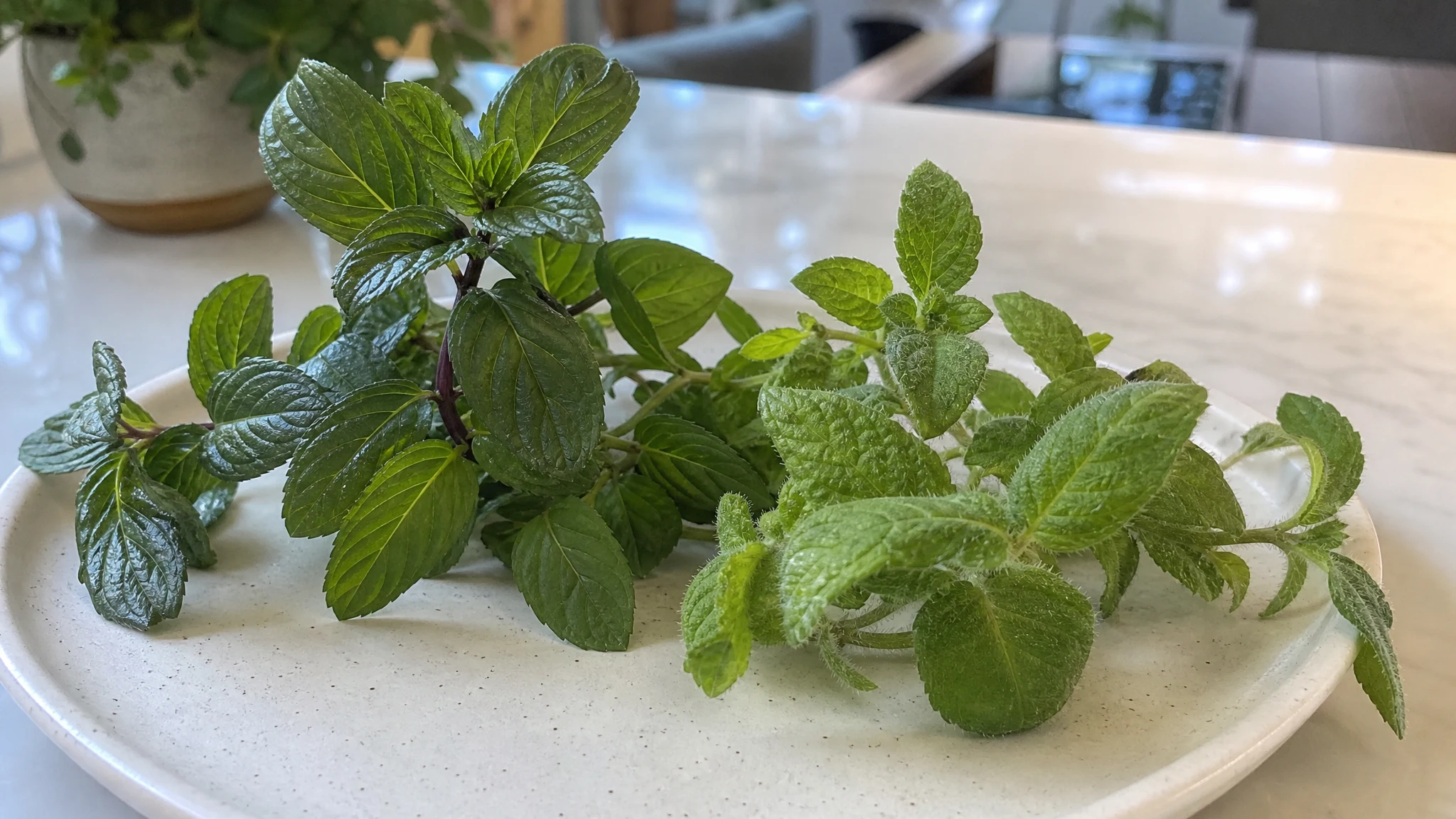
Mentha piperita vs arvensis: Peppermint and Cornmint Oil
"Peppermint oil" on a label can mean two different plants. Mentha piperita and Mentha arvensis (cornmint, field mint) are separate taxa with different typical chemistry, and we sell one oil of each, so this is the one article where our own two products sit side by side. Our position: neither is the better oil. They are different materials, and the only real error is buying one while believing you bought the other.
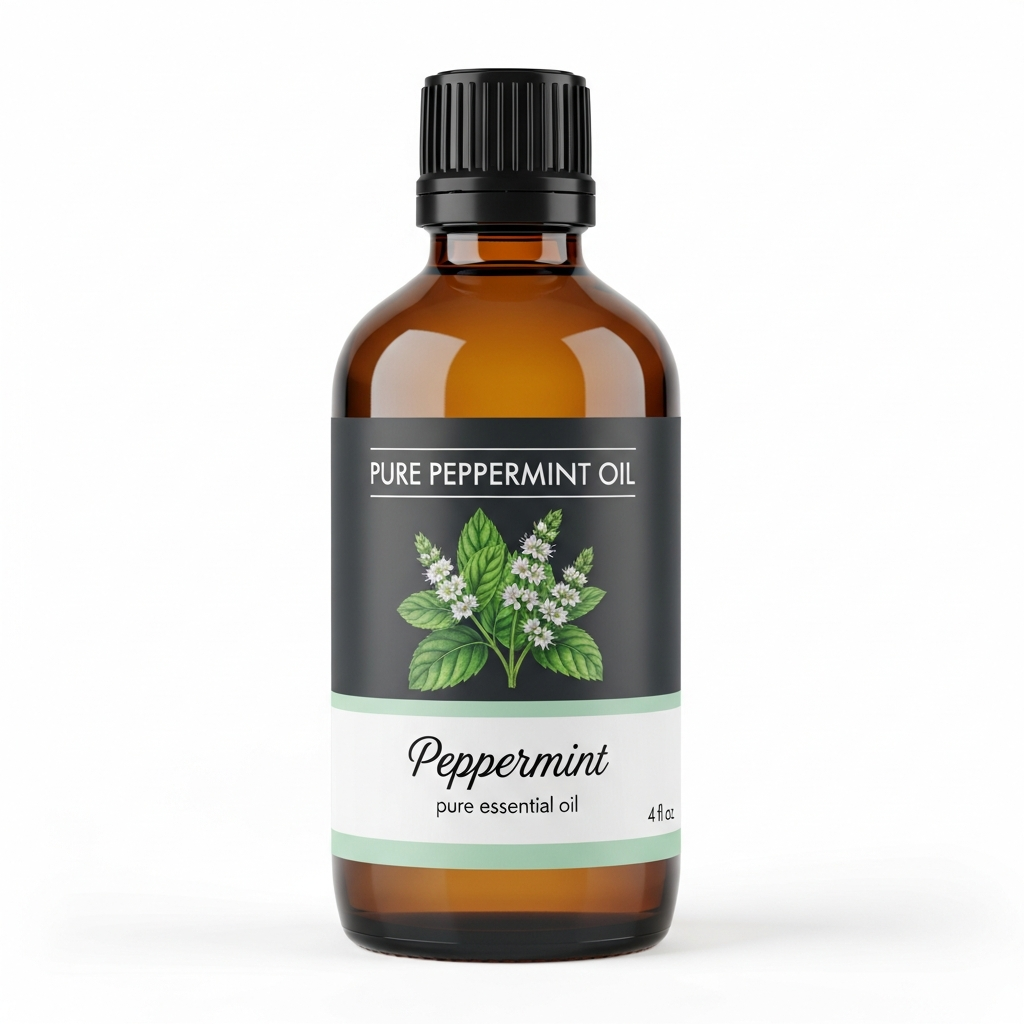
Peppermint Essential Oil
Our own Peppermint Essential Oil, in sizes from 0.5 oz to bulk.
From $10.99
Shop Now →Two plants, not two grades
USDA's germplasm database (USDA ARS GRIN, record verified 1993) lists Mentha x piperita L. in the family Lamiaceae with the hybrid parentage Mentha aquatica x M. spicata (watermint x spearmint). Peppermint is therefore a hybrid, not a species you can distil from a wild field of "peppermint". Mentha arvensis is a separate species. The GRIN record for Mentha arvensis var. piperascens, the Asian variety grown for menthol, lists it as a synonym of Mentha canadensis L. (USDA ARS GRIN, verified 1988). So "Mentha arvensis" on a bottle may be a trade name for a plant that botanists file under another name. That is a reason to ask a supplier which taxon and variety it means, not a reason to worry about the label.
Standards bodies treat the oils separately too. ISO 856:2006 covers oil of peppermint (Mentha x piperita L.) and was last confirmed in 2022 (ISO 856). ISO 9776:1999 covers oil of Mentha arvensis, partially dementholized, and was confirmed in 2025 (ISO 9776). The title of the second already shows that cornmint oil is often handled as a menthol source: part of its menthol can be removed. Its specification limits are behind a paywall and were not read for this article.
What the literature says about the chemistry (not our oils)
The figures below are general literature ranges, each from a different study design, and none is a statement about the oils we sell.
| Source | Material | Menthol | Other markers reported |
|---|---|---|---|
| CIR, 2018 (ISO 856 profile) | Peppermint, origins other than US | 32.0 to 49.0% | menthone 13.0 to 28.0; menthyl acetate 2.0 to 8.0; 1,8-cineole 3.0 to 8.0; menthofuran 1.0 to 8.0; pulegone 0.5 to 3.0 |
| EFSA, 2025 | Peppermint, 10 batches, GC-MS | mean 37.99 (35.64 to 45.80) | 1,8-cineole mean 5.17; menthofuran 3.31; pulegone 1.28 (0.48 to 1.72) |
| EFSA, 2026 | "Cornmint oil", 13 batches | GC-FID mean 40.8 (36.0 to 46.7) | 1,8-cineole mean 0.24; pulegone 1.13 (0.47 to 1.60); isomenthone mean 15.0 |
| Soltanbeigi et al., Industrial Crops and Products, 2022 | Turkish field trial, both species | piperita 22.5 to 44.6; arvensis 53.6 to 70.5 | oil content 4.8% (arvensis) vs 2.8% (piperita) |
| Makkar et al., J Food Sci Technol, 2018 | One M. arvensis cultivar | 77.94% | isomenthone 5.24; neomenthyl acetate 5.18 |
Three things follow, all from the table. First, "cornmint oil" is not one product: the EFSA batches average about 41% menthol, while the field-trial and cultivar studies report 54 to 78%. Whatever sits between is a matter of variety, harvest and whether the oil has been partly dementholised. Second, the overlap in menthol (EFSA's cornmint batches fall inside ISO's peppermint range) means menthol alone does not identify the species. Third, 1,8-cineole separates the two in these datasets: about 5% in the peppermint batches against under 0.35% in the cornmint ones. A buyer who wants to confirm a species should ask for a report that lists named compounds, not just a menthol figure.
What our two documents show, and do not
Our published certificate of analysis is for a Mentha x piperita sample and reports a single refractive index, 1.4596 +/- 0.0003. The CIR report gives 1.459 to 1.465 for pharmacopoeial peppermint oil, so the value sits inside that range, but one physical constant cannot show species, composition or freedom from additions. The sample is also not identified as one of our retail lots.
Our published GC-MS report is titled for Mentha arvensis, not piperita. It is qualitative, in area percent, and gives chemical-family totals: monoterpenol 71.19%, monoterpene ketone 11.47%, monoterpene 5.77%, monoterpene ether 4.94%, monoterpene ester 3.78%, with 99.04% identified in total, and a note that no adulterants, diluents or contaminants were detected by that method. A family total is not a menthol figure (the monoterpenol family contains menthol and other alcohols), area percent is not weight percent, and the report prints no batch number or date. Neither document says anything about the other oil.
So if you need numbers, here is what to do before ordering either oil: ask in writing for a species-matched, quantified GC-MS that names menthol, menthone, isomenthone, 1,8-cineole, pulegone and menthofuran for the lot you will receive, and get it in writing. We do not promise a specific document here; the point is to settle it before the purchase.
Adulteration: what the 2025 study actually tested
Zhao and colleagues (J Pharm Biomed Anal, 2025) used NMR on 50 commercial peppermint oils and reported an adulteration rate of 42%, listing synthetic chemicals, de-mentholised cornmint oil and lower-cost oils as adulterants. Read it for what it is: a method paper on commercial samples sold as peppermint oil, not a test of our oils or a statement about any single seller. It does show why the label has to name the species: cornmint sold under the name peppermint is a documented problem in the trade.
Choosing between them
| Question | Piperita | Arvensis (cornmint) |
|---|---|---|
| Shop description | "crisp, cool, and minty, with a faint candy-like sweetness"; top note | "bold, cooling, and sharply minty, with a strong menthol backbone"; top note |
| Uses on the product page | diffuser, diluted foot soaks and massage oil, cold-process soap, candles, lip balms, wintery home fragrance | diffuser, foot soaks, body butter, lip balm, soap, candles, cleaning sprays, room mists |
| Shop shelf-life figure | typically 3 to 5 years | typically 2 to 3 years |
| Name the finished product must carry | Mentha piperita | Mentha arvensis or cornmint, as your regulator or retailer requires |
Reasoning from the shop copy: if the sweetness matters to a candy-cane or holiday scent, start with piperita; if you want an assertive cooling note and a sharp edge in a room mist or cleaning spray, cornmint is the one described that way. Run it past your own nose in a small trial, because we have not made or tested any product with either oil. For a blend plan, the pairing guide applies to both, and the spearmint comparison covers a third mint.
One dilution line for both
Our own safety copy, on both product pages, says to dilute to 0.5% to 2% in a carrier oil, patch test first, keep away from eyes, children and pets, and never take it internally. Our distillation page adds that peppermint is potent: use one drop where you would use three of something gentler, and keep it away from an infant's or young child's face, where concentrated menthol can affect breathing. The NCCIH page on peppermint oil says the same about menthol and small children's breathing (NCCIH, May 2025).
External figures are higher than our top. A maximum dermal level of 5.4% for peppermint oil, derived from Tisserand and Young and reported by CIR (a secondary source for that figure), rests on 8% menthofuran and 3% pulegone content; CIR also records a highest cosmetic use level of 5% in 2017. We do not offer 5.4% as a target. For cornmint, no maximum was found in the sources read for this article, and EFSA's 2026 opinion says the oil should be considered an irritant to skin and eyes and a dermal and respiratory sensitiser. Our recommendation for face, scalp or body is the low end, 0.5% to 1%, which is about 3 to 6 drops in 1 oz (29.57 ml) of carrier at 20 drops per ml. A reaction is a question for a dermatologist or allergist.
If you are still deciding, the piperita page and the arvensis page carry the sizes, and the chemistry background is in Inside Peppermint Oil.
Peppermint Essential Oil
Peppermint Essential Oil from our own shop, in sizes from 0.5 oz to bulk.
From $10.99
Shop Now →Sources & Further Reading
- USDA ARS GRIN-Global. Mentha x piperita L. npgsweb.ars-grin.gov/24078
- USDA ARS GRIN-Global. Mentha arvensis var. piperascens. npgsweb.ars-grin.gov/24070
- ISO, 2006. ISO 856:2006 Oil of peppermint (Mentha x piperita L.). committee.iso.org/32041
- ISO, 1999. ISO 9776:1999 Oil of Mentha arvensis, partially dementholized. committee.iso.org/17638
- Cosmetic Ingredient Review, 2018. Amended Safety Assessment of Mentha piperita (Peppermint)-Derived Ingredients. cir-safety.org
- EFSA FEEDAP Panel, 2025. Safety and efficacy of peppermint oil (Mentha x piperita) for all animal species. EFSA Journal 23(1):e9076. PMC11733596
- EFSA FEEDAP Panel, 2026. Safety and efficacy of cornmint oil (Mentha arvensis L.) for all animal species. EFSA Journal 24(4):e10039. PMC13063794
- Soltanbeigi A, Ozguven M, Hassanpouraghdam MB, 2022. Planting-date and cutting-time affect the growth and essential oil composition of Mentha x piperita and Mentha arvensis. Industrial Crops and Products 170. europepmc.org
- Makkar MK, Sharma S, Kaur H, 2018. Evaluation of Mentha arvensis essential oil and its major constituents for fungitoxicity. J Food Sci Technol 55(9):3840-3844. PMID 30150845
- Zhao J et al., 2025. Characterization, differentiation, and adulteration detection of peppermint essential oil: an NMR approach. J Pharm Biomed Anal 263:116941. PMID 40339205
- NCCIH (NIH), 2025. Peppermint Oil: Usefulness and Safety. nccih.nih.gov