Natural Mouse Repellents Compared: What Each Source Says
Of the five things people try against house mice (sealing gaps, snap traps, peppermint oil, ultrasonic plug-ins and mothballs), the pages we could read support the first two and say little or nothing in favor of the other three. We sell peppermint oil, not a pest product, and we have run no mouse test of any kind, so this is a comparison of what a university IPM program, the CDC, the FTC and the EPA have published, with the gaps stated.
Peppermint Essential Oil
Our own Peppermint Essential Oil, in sizes from 0.5 oz to bulk.
From $10.99
Shop Now →The ranking, and the source behind each row
| Method | What the source says | Catch |
|---|---|---|
| Seal entry points | CDC: "Mice can fit through a hole the width of a pencil (1/4 inch or 6 millimeters in diameter)." UC IPM: eliminate gaps larger than 1/4 inch | Needs a walk-through of the whole building, and the right material |
| Snap traps | CDC: "Traditional snap traps are recommended to reduce rodent populations around the home." UC IPM: trapping is "a great first step" | Dead rodents need careful handling; keep traps from children and pets |
| Ultrasonic plug-ins | UC IPM: "High frequency electronic devices aren't effective"; mice "quickly become accustomed to regularly repeated sounds" | No control shown |
| Mothballs | EPA: use outside the label's named site is "unlawful" | A pesticide misuse problem, not a smell trick |
| Peppermint oil | Not named on any of those pages. UC IPM on rats: "no repellents have been found to solve a rat problem for more than a very short time" | No peer-reviewed mouse study could be read for this article |
Exclusion comes first because it is the only row that stays done
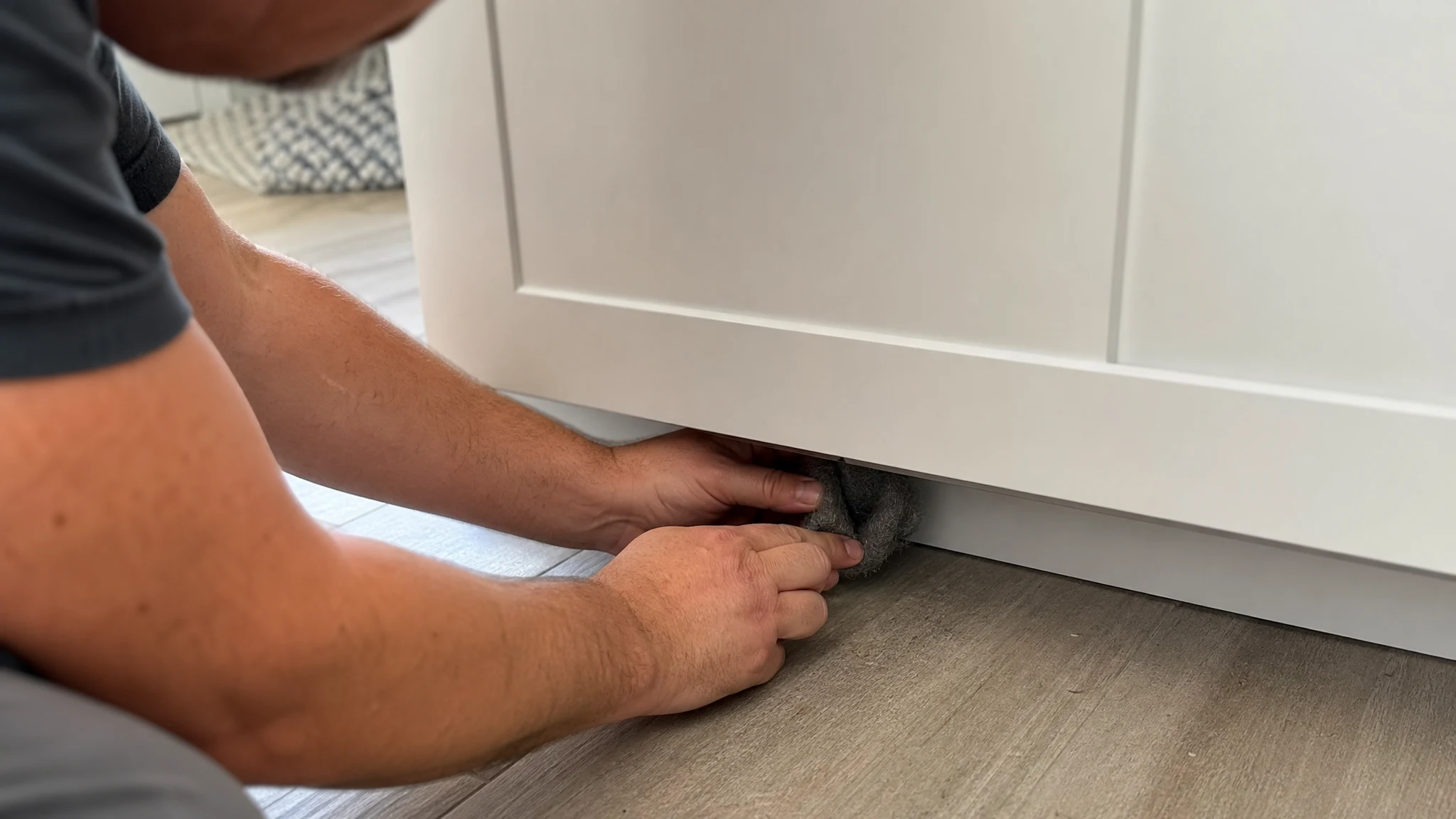
The CDC's seal-up page says to fill small holes with steel wool and "put caulk around the steel wool to keep it in place or use spray foam," and to use "lath screen or metal, cement, hardware cloth, or metal sheeting" for larger openings. UC IPM (updated July 2025) adds two details worth knowing before you buy materials: steel wool pads "make good temporary plugs but may rust over time," and plastic screening, rubber, vinyl, expanding foam and wood are "ineffective" because mice gnaw through them.
That is the mechanism that decides the whole comparison. A scent or a sound asks a mouse to stay out; a quarter-inch gap sealed with metal makes the question moot. Anything that does not touch the gap has to win, every night, against food, warmth and shelter on the other side of it.
Traps: where two agencies disagree
Both agree snap traps come first. They split on the rest. The CDC's trap-up page advises against glue and live traps because, it says, the frightened animal may urinate, "which can increase your chance of getting sick." UC IPM also describes multiple-capture live traps, electrocution traps and glue boards, with the caveat that animals on glue boards "might not die quickly." If you are choosing between those two positions, the CDC page is written for disease risk in a home and UC IPM for control in general; we cannot say which weighs more for your house, and a licensed pest professional can. Poison baits are a separate decision: the CDC says to use them only for infestations that persist and per the label, and UC IPM notes that rodenticides are toxic to people, pets and wildlife.
Ultrasonic devices: two agencies, one finding, and a regulator
UC IPM says ultrasonic sound has "very limited use in rodent control because they are directional" and that mice habituate. The FTC has acted on the marketing side: in May 2001 its staff sent warning letters to more than 60 makers and retailers of ultrasonic pest-control devices, saying efficacy claims need scientific support, and the release recalls earlier complaints alleging that rodent reactions to ultrasound are "temporary at best because rodents become accustomed to ultrasound" (FTC, 2001). Those were allegations in complaints, not court findings, and the release is twenty-five years old; the UC IPM statement is the current one.
Mothballs: the legal problem is bigger than the smell
EPA's labeling Q&A takes up a close cousin of the mouse question, whether placing mothballs on the grass along a fence line to deter cats is allowed. The answer is no: registered mothball labels name the site "air-tight containers and storage closets," so use anywhere else is "unlawful," and no registered mothball product is approved for cats (EPA, Q&A of 26 June 2009). The page is about cats, not mice, so applying it to mice is our inference: a mothball scattered in an attic or wall void is also not in an airtight container. We read nothing on mothballs on the UC IPM mouse page, which does not mention them.
Where peppermint oil fits, and what we could not verify
This is the row we would most like to fill with a number, and cannot. We searched Europe PMC for peer-reviewed work on peppermint and rodent repellency and found nothing on mice or rats we could read. UC IPM's rat page (updated June 2025) says rats have "an initial aversion to some odors and tastes, but no repellents have been found to solve a rat problem for more than a very short time," without naming peppermint. That is the best-sourced statement we have, and it is about rats. The reasoning from it: a scent that fades in days, in a room where food and gaps remain, buys little.
One regulatory fact gets misread. Peppermint oil and cornmint oil are on the EPA's list of active ingredients that can be used in "minimum risk" pesticide products without registration (40 CFR 152.25), and such labels may not claim to control rodents "carrying specific diseases." Being on that list is an exemption from registration, not a finding that the oil works on mice; that reading is ours, and the section text does not address efficacy.
If you still want the scent in a storage room, treat it as fragrance. Our own safety copy says to keep it away from children and pets and never to take it internally, and the ASPCA lists mint (Mentha sp.) as toxic to dogs, cats and horses (ASPCA plant page); our cat post and safety basics cover that ground. Do not spray oil on wiring or engine parts; for vehicles, ask the manufacturer or a mechanic, and see the vehicle and storage post. For a household walkthrough of peppermint oil and mice, see our mouse post.
What to do this week
- Walk the outside and the cupboards under sinks with a pencil as the gauge; anything it fits through is a gap.
- Plug with metal (steel wool with caulk over it, hardware cloth or sheet metal for larger holes), not plastic or foam alone.
- Set snap traps along walls, out of reach of children and pets, and check them daily, as the CDC advises.
- If activity continues after sealing and trapping, call a licensed pest professional, who can trace the entry point you missed.
Whatever you decide on scent, decide it after the gaps are closed. Our two peppermint oils, Mentha piperita and Mentha arvensis, are sold as fragrance materials, and nothing on this page says either one controls a pest.
Peppermint Essential Oil
Peppermint Essential Oil from our own shop, in sizes from 0.5 oz to bulk.
From $10.99
Shop Now →Sources & Further Reading
- CDC. How to Seal Up to Prevent Rodents. cdc.gov/healthy-pets/rodent-control/seal-up
- CDC. How to Trap Up to Remove Rodents. cdc.gov/healthy-pets/rodent-control/trap-up
- UC IPM, 2025 (updated 07/2025). House Mouse, Pest Notes 7483. ipm.ucanr.edu/home-and-landscape/house-mouse
- UC IPM, 2025 (updated 06/2025). Rats, Pest Notes 74106. ipm.ucanr.edu/PMG/PESTNOTES/pn74106
- FTC, 2001. FTC Warns Manufacturers and Retailers of Ultrasonic Pest-Control Devices. ftc.gov press release
- EPA, 2009. Pesticide Labeling Questions & Answers (mothballs, LC09-0269). epa.gov/pesticide-labels
- US EPA via eCFR, 2026. 40 CFR 152.25, exemptions for pesticides of a character not requiring FIFRA regulation. ecfr.gov/title-40/part-152/section-152.25
- ASPCA. Mint (Mentha sp.), toxic and non-toxic plants. aspca.org mint