
Peppermint Oil and Nausea: What the Inhalation Trials Measured
Trials of peppermint aroma for nausea have measured small changes on a 0 to 10 scale, in people in clinics, usually after surgery, chemotherapy or in pregnancy, and the authors of the largest recent review rated the certainty as low for every outcome. That is a long way from "sniff the bottle when you feel sick", and our oils, sold neat and labelled for home fragrance, soap and candles rather than for any condition, are not a nausea product.
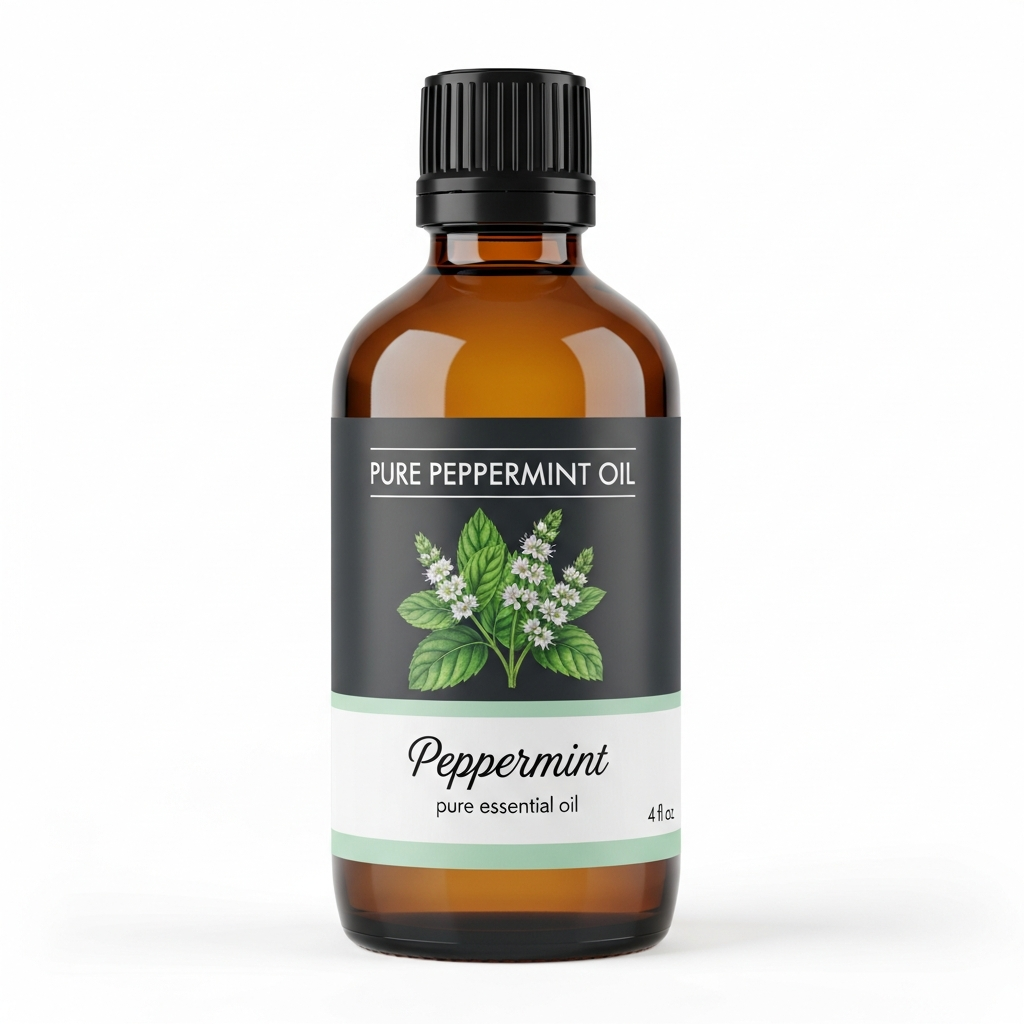
Peppermint Essential Oil
Our own Peppermint Essential Oil, in sizes from 0.5 oz to bulk.
From $10.99
Shop Now →The Cochrane review: aromatherapy in general
Hines and colleagues, 2018, in the Cochrane Database of Systematic Reviews, looked at aromatherapy for postoperative nausea and vomiting. They included 16 studies with 1,036 participants. Aromatherapy did not clearly reduce nausea severity compared with placebo, and the evidence was low quality. Participants given aromatherapy were less likely to need rescue anti-sickness medication. The authors concluded that the findings are uncertain because they rest on low-quality evidence. The record we fetched gives the headline results, not the peppermint-only subgroup numbers, so we do not quote a peppermint-specific figure from it.
The 2025 meta-analysis: peppermint inhalation
Gergő and colleagues, 2025, in the Journal of Clinical Medicine, pooled 19 randomized trials of inhaled peppermint oil for nausea and vomiting: 14 in the quantitative analysis (8 postoperative, 3 chemotherapy, 3 pregnancy) and 5 described but not pooled. The baseline numbers in the pooled sets were 453 postoperative patients (233 peppermint, 220 control), 264 on chemotherapy (128 and 136) and 283 pregnant participants (189 and 94). Nausea was scored on a 0 to 10 scale.
| Setting | Result reported (mean difference, peppermint minus control) | Where it was not significant |
|---|---|---|
| After surgery | -0.60 (95% CI -0.77 to -0.44) at 2 to 6 hours | 5 minutes, 0 to 2 h, 6 to 12 h, 12 to 24 h, 24 to 48 h |
| Pregnancy | -0.51 (-0.78 to -0.24) at 48 h; -0.68 (-1.09 to -0.27) at 96 h | 24 h and 72 h |
| Chemotherapy | -1.85 at 24 h; -2.23 at 48 h; -2.41 at 72 h; -2.11 at 96 h | none reported as non-significant |
The authors themselves call the work exploratory. They state that the postoperative and pregnancy improvements were generally below the minimal clinically important difference of about 1.5 points on the 0 to 10 scale. Our arithmetic on their own numbers: the postoperative effect of 0.60 is 40% of that threshold, and the pregnancy effects of 0.51 and 0.68 are 34% and 45%. Only the chemotherapy results exceed 1.5, and those pooled studies disagreed with each other considerably (heterogeneity of 60% to 83% across time points).
Their stated limitations are the ones to carry away: few trials with small samples; different outcome scales converted to 0 to 10; controls that were sometimes placebo, sometimes an active comparator and sometimes nothing; blinding that was difficult because everyone can smell peppermint, so expectation and the act of inhaling cannot be separated from any effect of the oil; most studies from Iran, Turkey and the United States; little systematic safety reporting. GRADE certainty was low for every outcome. The portion of the paper we read did not give the oil concentrations or delivery devices, so we cannot tell you what exposure the studied patients had, only that it was supervised inhalation rather than an open bottle.
Why that is not a home recipe for our oils
- Different exposure. The trials studied inhaled peppermint oil under study conditions. A neat essential oil held under the nose is a stronger and less controlled exposure, and our own safety copy says to keep the oil away from the eyes, children and pets. Our distillation page says not to apply it near the face of an infant or young child, where concentrated menthol can affect breathing, and NCCIH, May 2025 says the same of menthol.
- Different oil. Which peppermint oil the trials used is not something we can say from what we read. We sell Mentha piperita and Mentha arvensis (cornmint); the published certificate of analysis is a single refractive index for a piperita sample, and the published GC-MS report is for the cornmint oil in family totals. Neither document tells you what a given bottle will smell like to a person who feels ill.
- Smell can make nausea worse. The NHS nausea page advises avoiding strong-smelling foods and surroundings. A strong mint can be the wrong thing for some people. That is a reasoned caution, not a study result.
Do not skip the ordinary thresholds
The NHS says to see a GP if you are feeling sick and do not feel better in a few days, or if you often feel sick and it keeps coming back, and to call 111 if you cannot get a GP appointment. It says to call 999 if sudden nausea comes with chest pain that feels tight or heavy, pain spreading to the arms, back, neck or jaw, or shortness of breath, which can signal a heart attack. It warns that if you are being sick you could become dehydrated, though the page does not itself list the signs (it points to a separate vomiting page, which we did not read). Its self-care list includes fresh air, sipping cold drinks, ginger or peppermint tea, small frequent meals, and avoiding hot, fried or greasy foods. That list refers to tea as a drink. We are not suggesting you swallow an essential oil, and our oils are labelled not for internal use.
For pregnancy, the three pregnancy trials in the 2025 review are not an invitation to try a neat oil. NCCIH, May 2025 says that peppermint in food amounts is likely safe in pregnancy and breastfeeding, that medicinal amounts are less studied, and that little is known about them. Persistent vomiting in pregnancy is a question for an obstetric clinician or midwife. Our reading of the same literature on skin and aroma use is in peppermint oil in pregnancy. No verified source on motion sickness was found, so this page says nothing about it.
Where this leaves a buyer
If you are comparing options for persistent nausea, a pharmacist or physician is the person to ask, and they can say whether anything in your medicines matters. If you buy our oils for home fragrance or for making soaps and candles, that is what they are sold for. The gut-side evidence for peppermint, which involves capsules and a different condition, is on a separate page, peppermint oil and IBS. For the wider picture of what has and has not been shown, see peppermint oil benefits, honestly and the safety basics.
If an essential oil is swallowed, especially by a child, call Poison Help at 1-800-222-1222.
A 0.6-point change on a ten-point scale in supervised trials is the honest size of the finding, and it does not stretch to a bottle on a shelf.
Peppermint Essential Oil
Peppermint Essential Oil from our own shop, in sizes from 0.5 oz to bulk.
From $10.99
Shop Now →Sources & Further Reading
- Gergő D et al, 2025. Inhaling Peppermint Essential Oil as a Promising Complementary Therapy in the Treatment of Nausea and Vomiting. J Clin Med 14(14):5069. pmc/PMC12294836
- Hines S, Steels E, Chang A, Gibbons K, 2018. Aromatherapy for treatment of postoperative nausea and vomiting. Cochrane Database Syst Rev 3 (abstract record via Europe PMC, PMID 29523018). europepmc/29523018
- NHS. Feeling sick (nausea). nhs.uk/conditions/feeling-sick-nausea
- National Center for Complementary and Integrative Health, May 2025. Peppermint Oil: Usefulness and Safety. nccih.nih.gov