
Peppermint Oil and Sore Muscles: What Menthol Actually Does
Menthol makes skin feel cold without lowering its temperature, and that is the whole story of the "cooling rub" sensation. It says nothing about what is happening in a sore muscle, and the trials of menthol gels are small and mixed. Our peppermint oils are cosmetic-use aromatics sold neat, with no muscle or pain claim, and what follows explains why we would not turn them into a rub.
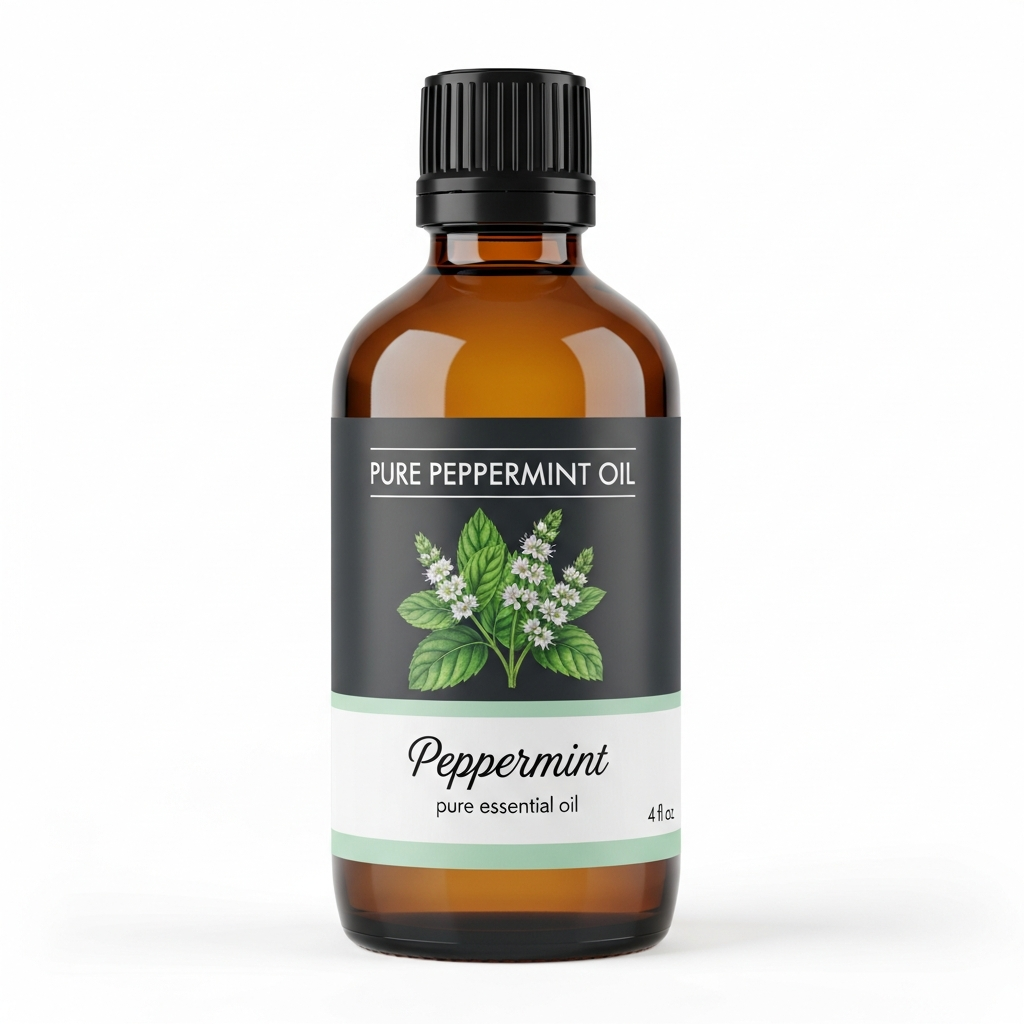
Peppermint Essential Oil
Our own Peppermint Essential Oil, in sizes from 0.5 oz to bulk.
From $10.99
Shop Now →The mechanism: a cold alarm with no cold
Peier and colleagues, 2002 cloned a channel called TRPM8 and reported that cells expressing it respond to both cold and menthol; the channel is found in a subset of neurons that sense temperature and pain. The abstract does not describe muscle. The reasoning that follows from it: menthol on skin can switch on cold-reporting nerves, so the skin feels cool while its measured temperature stays where it was. A sensation can distract from an ache. It does not repair a strained fibre, and none of the sources below claims it does.
The menthol gel trials
We read two small trials, and neither used essential oil.
- Topp, Brosky and Pieschel, 2013, in the Journal of Geriatric Physical Therapy: 20 adults with knee osteoarthritis put on a 3.5% menthol gel or an inert placebo gel across two visits a week apart, then did functional tasks and rated pain. The between-group differences were not significant. Within each group some scores changed, and the authors described the result as only partial support for the gel. That is osteoarthritis of the knee, not a sore muscle after exercise.
- Sundstrup and colleagues, 2014, in Rehabilitation Research and Practice: 10 slaughterhouse workers with carpal tunnel syndrome and chronic arm and hand pain, in a triple-blind randomized crossover. Menthol gel (a commercial product) was compared with a menthol-scented placebo gel on working days, 48 hours apart. Pain intensity fell 1.2 points on a 0 to 10 scale compared with placebo (95% CI -1.7 to -0.6, P = 0.026). Ten people, one workplace, nerve pain, acute effect only.
Neither is a study of exercise-related soreness, and neither tests a peppermint essential oil. We did not find a Cochrane review of menthol alone that we could verify, and we found no trial of peppermint essential oil on sore muscles. The honest summary is a sensation with a small, uncertain effect in two small trials of other conditions.
What 3.5% menthol means in oil terms
This is our arithmetic and not a measurement of any bottle. EFSA, 2025 reported ten batches of Mentha x piperita oil with a mean menthol content of 43.42% (range 42.51 to 45.54, specification 30 to 55). To make a blend with 3.5% menthol from an oil at 43.42% you would need about 8.1% oil (3.5 divided by 0.4342). Our shop copy gives 0.5% to 2%. A 2% blend would carry about 0.87% menthol, roughly a quarter of the gel strength used in the knee trial. We publish no menthol figure for either of our oils, and the one chemistry document we publish, the GC-MS report, is for the cornmint (arvensis) oil in family totals, so the 43.42% is a literature value used only to show scale.
Two consequences. First, the trial concentration is about four times our top figure, so the trial result cannot be borrowed for a 2% blend. Second, getting to trial strength with oil would mean a blend well above the range we stand behind, which is the wrong direction for a skin-irritating material.
Why concentration is the wrong thing to chase: the FDA burn warning
The FDA, 13 September 2012 drug safety communication reported rare cases of serious burns, first to third degree, from over-the-counter creams, lotions, ointments and patches containing menthol, methyl salicylate or capsaicin. It identified 43 cases between 1969 and April 2011 across adverse-event reports and the literature. Most second- and third-degree burns involved products with menthol as the only active ingredient, or menthol and methyl salicylate with more than 3% menthol and more than 10% methyl salicylate. In many cases, severe burning or blistering followed within 24 hours of the first application. The FDA's advice includes not applying to damaged or irritated skin, not using bandages over the area, avoiding heat sources such as heating pads, and keeping the products away from the eyes and mucous membranes; anyone with pain, swelling or blistering should stop and get medical attention. We read this communication through a search result, not its full page, so treat the details as the FDA's summary as reproduced there.
Putting the numbers side by side (ours): more than 3% menthol is, at the EFSA mean of 43.42% menthol, a blend of about 6.9% oil. That is not our recommendation and it is not a threshold for our oils. It tells you why "more oil, stronger effect" is a poor plan.
What we say instead
- If you are going to use a diluted blend on skin for its scent, our copy says 0.5% to 2% in a carrier oil, with a patch test first. Our recommendation is the low end, 0.5% to 1%, because menthol irritates and peppermint is potent. One ounce (29.57 ml) of carrier at 1% is about 0.3 ml, roughly 6 drops at about 20 drops to the millilitre. Measure it, and see how to dilute peppermint oil.
- No heat over it, no wraps. The FDA advice for menthol products applies by reasoning to a blend you make: avoid heating pads and tight bandaging over the area, keep it off broken skin, and keep it away from the eyes.
- No children's faces. Our distillation page says not to apply it near the face of an infant or young child, where concentrated menthol can affect breathing. NCCIH says the same of menthol.
- We have not made or tested a rub. There is no rub recipe on this page, by design.
The foot-soak and mist ideas in our hot-day guide are fragrance uses, and the same caution applies to them.
When sore is not just sore
The NHS sprains and strains page says to see a GP if an injury is getting worse or not improving after self-care. It says to call 111 or go to an urgent treatment centre if it is very painful or getting worse, if swelling or bruising is large or growing, if you cannot put weight on it, if it is very stiff, or if you have a very high temperature or feel hot, cold and shivery. It says to call 999 or go to A&E if you heard a crack, the body part has changed shape, the area is numb or tingling, or the skin looks blue or grey or feels cold. Its first-days self-care is rest, support, ice wrapped in a cloth for up to 20 minutes every two to three hours, compression and elevation, and it advises a pharmacist for painkillers and anti-swelling gels. That is the direction for a real injury: a pharmacist, a GP or a physical therapist, not an aromatic oil.
Related pages: peppermint oil safety basics and what the headache trials tested, which does the same arithmetic on a different claim.
A cold-feeling gel is not an injury plan, and a cosmetic oil is not a gel.
Peppermint Essential Oil
Peppermint Essential Oil from our own shop, in sizes from 0.5 oz to bulk.
From $10.99
Shop Now →Sources & Further Reading
- Peier AM et al, 2002. A TRP channel that senses cold stimuli and menthol. Cell 108(5):705-715. pubmed/11893340
- Topp R, Brosky JA, Pieschel D, 2013. The effect of either topical menthol or a placebo on functioning and knee pain among patients with knee OA. J Geriatr Phys Ther 36(2):92-99 (abstract record via Europe PMC, PMID 22976810). europepmc/22976810
- Sundstrup E et al, 2014. Acute effect of topical menthol on chronic pain in slaughterhouse workers with carpal tunnel syndrome. Rehabil Res Pract 2014. pubmed/25298894
- U.S. Food and Drug Administration, 13 September 2012. FDA Drug Safety Communication: Rare cases of serious burns with the use of over-the-counter topical muscle and joint pain relievers. fda.gov/Drugs/DrugSafety/ucm318858
- NHS. Sprains and strains. nhs.uk/conditions/sprains-and-strains
- EFSA FEEDAP Panel, 2025. Safety and efficacy of a feed additive consisting of an essential oil derived from the aerial parts of Mentha x piperita L. (peppermint oil). EFSA Journal 23(1):e9076. pmc/PMC11733596
- National Center for Complementary and Integrative Health, May 2025. Peppermint Oil: Usefulness and Safety. nccih.nih.gov