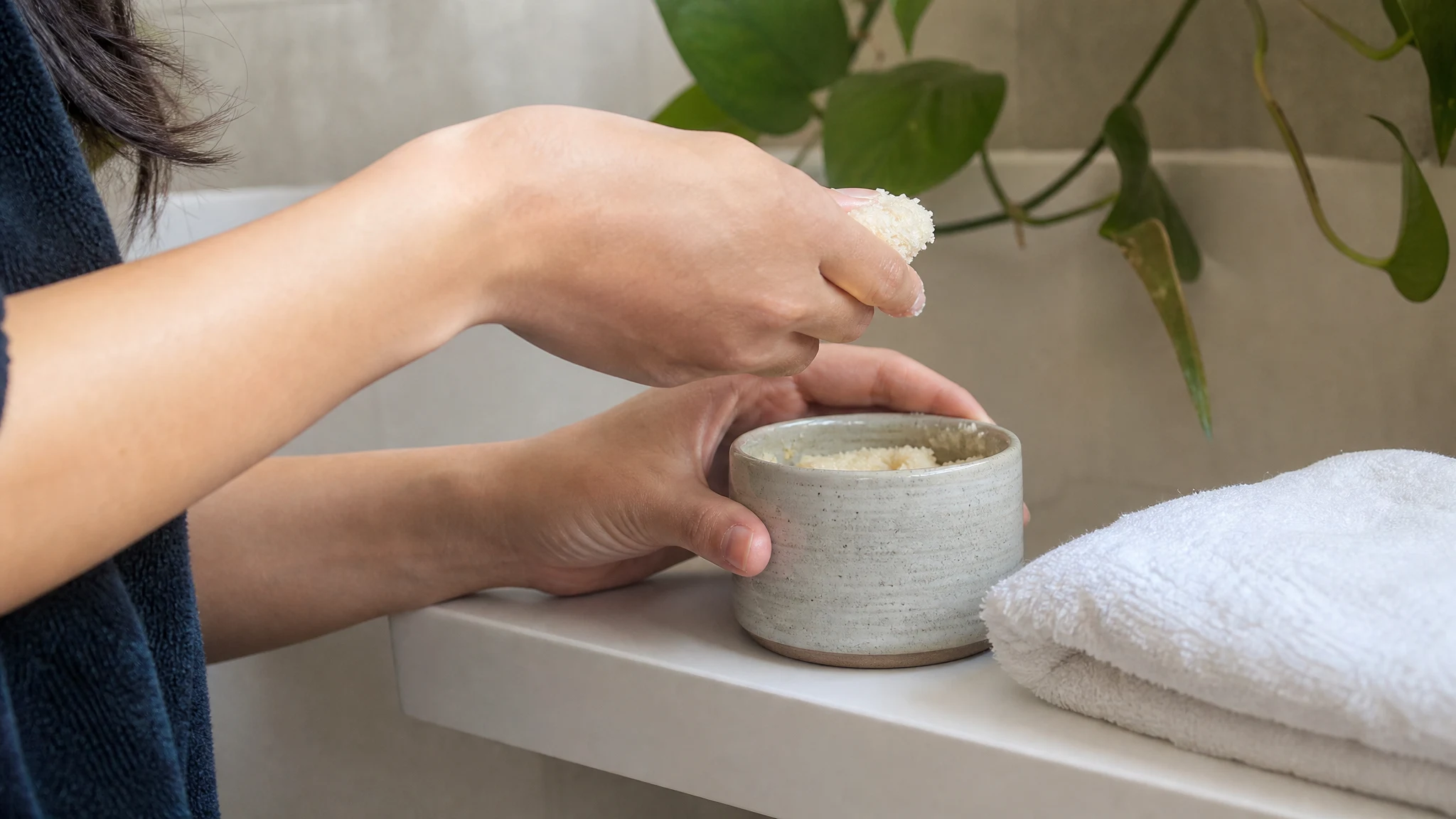
DIY Peppermint Sugar Scrub: The Arithmetic for 100 g
A sugar scrub is a rinse-off product made of three things: sugar, a carrier oil and, if you add it, a small amount of peppermint oil. The arithmetic is simple, but two details decide whether it is a good idea: how much peppermint a 100 g batch can take, and what happens when water gets into the jar. Everything below is a formulation worked out from cited guidance and arithmetic. We have not made it or tested it, so make a small batch and patch test before you use it.
Peppermint Essential Oil
Our own Peppermint Essential Oil, in sizes from 0.5 oz to bulk.
From $10.99
Shop Now →The batch, by weight
Weigh, do not scoop. We publish no density for either of our oils, and a kitchen scale that reads to 0.1 g takes the guesswork out. The starting point is a supplier's published proportions for an emulsified scrub: Wholesale Supplies Plus (December 2025) lists white granulated sugar at 66%, oils at 17 to 20%, butter about 7%, emulsifying wax and stearic acid about 3% each, preservative at 0.5% and fragrance at 0 to 2% (Wholesale Supplies Plus, 2025). We take only the 66% sugar share and leave water, wax and emulsifier out, which makes ours a different product. The supplier page does not give a water-free formula, so the oil share below is our adaptation, not theirs.
| Ingredient | Grams in 100 g | Note |
|---|---|---|
| White granulated sugar | 66 | grocery store |
| Liquid carrier oil | 33 | craft or aromatherapy supplier; one you already tolerate |
| Peppermint oil | 1 | about 1 ml; see below |
If the mix looks dry, add carrier a gram at a time; if it looks wet and pooled, add sugar. Keep the peppermint at a fixed 1 g and adjust the carrier, not the other way round.
How much peppermint, and why 1 g
Our shop copy says 0.5% to 2% in a carrier. In 100 g, that is 0.5 g to 2 g of oil. Using the specific gravity of 0.896 to 0.908 the Cosmetic Ingredient Review lists for peppermint oil, general literature and not a figure for our oils, 1 g is about 1.1 ml, or roughly 22 drops at 20 drops per ml. So 0.5% is about 11 drops and 2% about 44 drops (CIR, 2018).
What outside sources say about the right level for a rinse-off product is thin. The same CIR report records the highest reported use of peppermint oil as 1.9% in rinse-off products and 5% in face and neck leave-on products, from industry survey data on 815 products. Those are reported maxima, not limits. Its 5.4% maximum dermal level is secondary, credited to Tisserand and Young. We could not verify any IFRA standard or rinse-off limit for peppermint or cornmint oil, and no verified maximum for cornmint was available to us at all. So we state our own recommendation: 0.5% to 1%, which is 11 to 22 drops in 100 g, with 1 g as the batch above. Our reasoning is that a scrub is rubbed for minutes, in a warm shower where menthol vapour rises toward your face. Our distillation page says one drop where you would use three of something gentler, and that is the right instinct. Start at 0.5% (0.5 g) if you are using the Mentha arvensis (cornmint) oil, because its shop copy describes a strong menthol backbone.
The CIR report cites a case report of vulval allergic contact dermatitis due to peppermint oil. We take the point as a reason to keep the scrub off the genital area, which is our inference from that title and not a finding we read in full.
The water problem, which the "anhydrous" label hides
Wholesale Supplies Plus says water introduced during use eventually leads to bacterial growth in an emulsified sugar scrub, and it adds a preservative for that reason. Their page does not discuss water-free scrubs, so the common claim that an oil-and-sugar scrub needs no preservative is not something that source supports. Our reasoning: a water-free mix starts with no water, but a wet spoon, wet hands or shower spray puts some in. We sell no preservative and cannot advise on one: that is a question for the preservative's supplier and a cosmetic chemist. What you can do without one is limit the exposure:
- Make a small batch, such as the 100 g above, and use it within a short time. We cannot give a verified shelf life.
- Use a clean, dry spoon, and keep the jar out of the shower spray.
- Throw it out if it smells off, changes colour or shows any growth.
- Store it capped, in a cool, dark place away from heat and sunlight, which is what our shop says for the oil itself.
The FDA states that whether something is a cosmetic or a drug depends on its intended use, shown by labelling and promotional claims, and lists a massage oil marketed to relieve muscle pain as a drug while one that only moisturises and scents the skin is a cosmetic (FDA). If you ever sell scrubs, a claim such as "for tired feet" or "for sore muscles" would move it out of that category. Before selling any, talk to a product-safety attorney or a regulatory consultant.
Where not to use it, and the patch test
- Face, eyes, lips and nose. Sugar is abrasive and menthol is a problem near the eyes. If it gets in an eye, start rinsing with lukewarm water and call 1-800-222-1222 (Missouri Poison Center).
- Broken, freshly shaved or sunburned skin. Poison.org says not to use essential oils on damaged skin (poison.org). Freshly shaved skin and sunburn are our extension of that, by reasoning.
- Children. Our distillation page says not to apply it near the face of an infant or young child, and NCCIH (May 2025) warns against menthol on the face of infants and small children (NCCIH, 2025). Do not use it for bathing a child; ask a paediatrician.
- Slippery floors. An oil scrub leaves a film on skin and tub. Rinse the tub and use a non-slip mat. This one is common sense, not a sourced finding.
Patch test first. The American Academy of Dermatology says to try a product on a quarter-sized spot where it will not be rubbed or washed away, twice daily for seven to 10 days, and for a rinse-off product to leave it on for the usual time (it gives about five minutes for a cleanser). A reaction means gently washing it off and not using it again (AAD). A person with eczema or a history of fragrance reactions should ask a dermatologist before trying it.
What to read next
For the carrier choice see carrier oils for peppermint oil; for percentages in other containers see the dilution guide; for a different formulation, the foot soak and body mist post; and for the general rules, safety basics.
A scrub with 1 g of oil in 100 g has plenty of scent for the shower, and a larger dose adds mostly risk.
Peppermint Essential Oil
Peppermint Essential Oil from our own shop, in sizes from 0.5 oz to bulk.
From $10.99
Shop Now →Sources & Further Reading
- Wholesale Supplies Plus, December 2025. Emulsified sugar scrub formula tips. wholesalesuppliesplus.com
- Cosmetic Ingredient Review, 2018. Safety assessment of Mentha piperita (peppermint)-derived ingredients as used in cosmetics. cir-safety.org/pepper032018rep.pdf
- American Academy of Dermatology. How to test skin care products. aad.org
- U.S. FDA. Is it a cosmetic, a drug, or both? (Or is it soap?) fda.gov
- Missouri Poison Center. Essential oils. missouripoisoncenter.org
- poison.org (America's Poison Centers). Essential oils. poison.org/articles/essential-oils
- NCCIH (NIH), May 2025. Peppermint oil: usefulness and safety. nccih.nih.gov/health/peppermint-oil