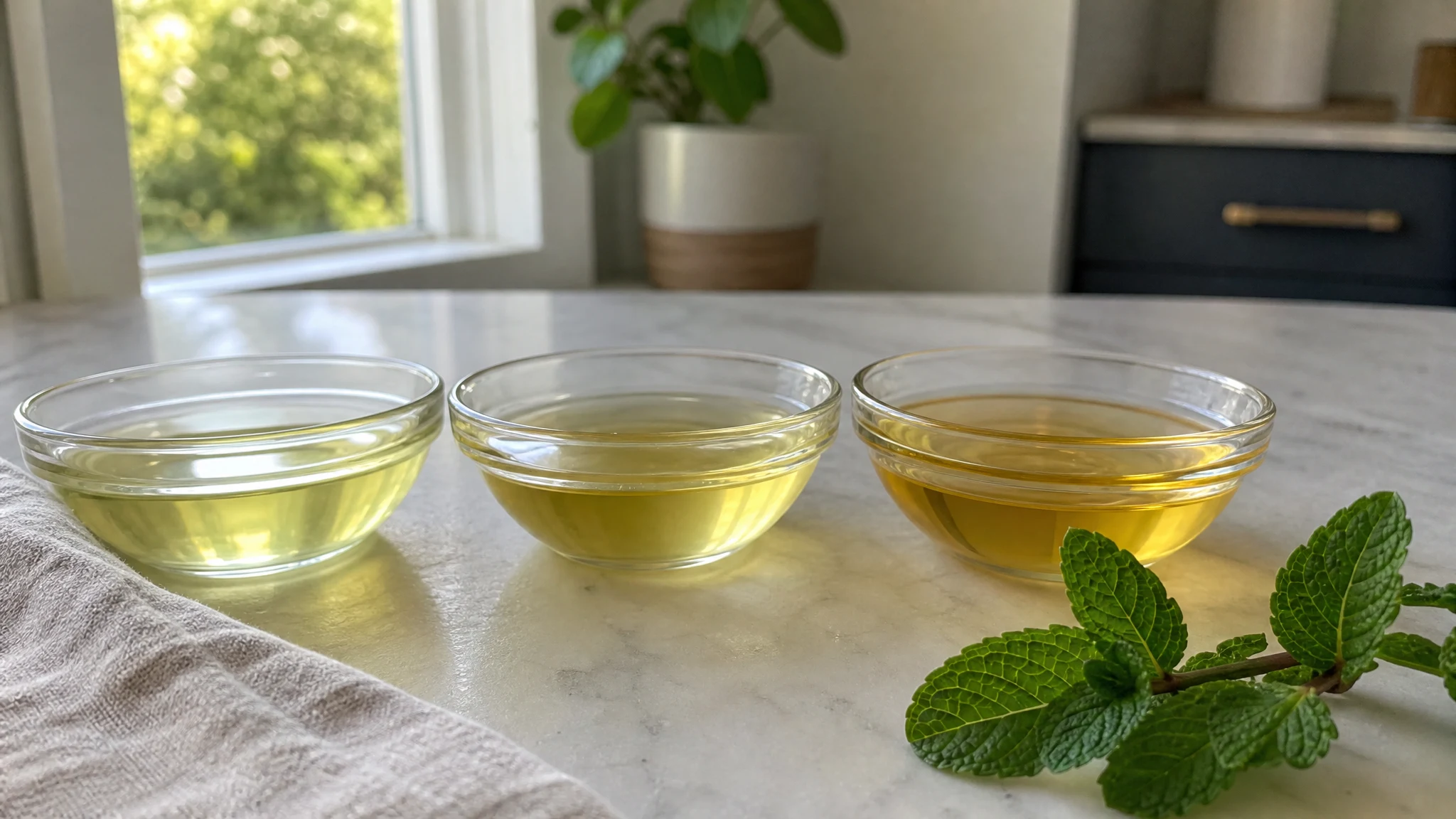
Carrier Oils for Peppermint: How to Choose One
Here is a thought that surprises people: when you dilute peppermint oil to 0.5% to 2%, more than 98% of what ends up in the bottle is the carrier. The peppermint gets all the attention, but the carrier decides how the blend feels, how long it lasts and who can safely use it. Two questions settle most choices. How long will this blend sit in the bottle, and is anyone who touches it allergic to the carrier?
Peppermint Essential Oil
Our own Peppermint Essential Oil, in sizes from 0.5 oz to bulk.
From $10.99
Shop Now →We sell our peppermint oils neat and no carrier oils, so what follows is a guide to choosing one from published composition and stability data, plus what to ask your supplier.
Why double bonds decide shelf life
Vegetable oils are mostly fatty acids, and the number of double bonds in those fatty acids largely determines how readily they oxidise and turn rancid. A 2025 review of vegetable oil oxidation reports that adding one double bond to a fatty acid (stearic to oleic) makes oxidation about ten times faster, and that a fatty acid with two double bonds can oxidise 10 to 40 times faster than one with a single bond. The same review notes that oxidation roughly doubles with every 10 C rise in temperature, that light speeds it up, and that reducing the oxygen in a bottle's headspace from over 15% to 3% extended one oil's shelf life from 60 to 180 days.
Put that next to the composition data. In a gas chromatography study of 14 vegetable oils, coconut oil was overwhelmingly saturated fat, with saturates up to 92% of its fatty acids. Sweet almond oil and olive oil were mainly oleic acid, with one double bond, at about 68% each. Grapeseed and safflower oils were dominated by polyunsaturated fats, with two or more double bonds. Reasoning from the two sources together, which is our inference and not a measured shelf life, grapeseed and safflower are the likeliest to turn first, almond and olive sit in the middle, and the mostly saturated coconut oils are the steadiest. Fractionated coconut oil is a processed portion of coconut oil rather than the oil in that study, so ask the supplier for its fatty acid profile.
Jojoba is the odd one out. A 2017 review describes it as rich in wax esters rather than the triglycerides that make up most plant oils, which sets it apart from the others. We would ask any jojoba seller whether the oil is crude or refined, and what the best-by date is.
The practical rule: your blend will not outlast the carrier it sits in. Treat the carrier supplier's best-by date as the ceiling, and put the date you made the blend on the label.
Allergies come before skin feel
If anyone using or handling the blend has a tree nut allergy, take sweet almond off the list before you compare anything else. The FDA names tree nuts among the major food allergens, and almond is a tree nut. That law concerns food labelling, so it tells you almond is a recognised allergen rather than how to handle a skin blend, but it is reason enough to choose a different carrier for a shared or gifted product and to label it with the carrier's name. For anyone with a history of allergic reactions, an allergist is the right person to ask, not a blog.
Matching the carrier to the plan
- A body or roller blend you want to keep for months. Look to low-unsaturation choices such as jojoba or a fractionated coconut oil, and check the best-by date.
- A quick batch used within a few weeks. Almost any liquid carrier that suits the user will do. Choose by allergen status and feel, and keep the bottle capped, cool and dark.
- A roller bottle. A thin, pourable carrier is easiest to fill. As arithmetic, 10 ml of carrier takes about 1 to 4 drops of oil for 0.5% to 2% (at roughly 20 drops per ml).
- Anything near the eyes. Keep peppermint well away from them whatever the carrier.
Our rollerball formulas show these ratios worked through, and the dilution guide covers the percentages in more detail.
What to ask the carrier seller
The fatty acid profile or analysis for the lot, whether the oil is crude, refined or deodorised, the best-by date, the allergen statement, and whether the container is dark glass or opaque. Then date the bottle when you open it. We do not rank carriers for pores or other skin outcomes, because we could not verify a reliable source for that.
Feel is personal
Beyond shelf life and allergens, a carrier comes down to how it feels in your hands. Rub a drop of each candidate between your fingertips before you commit. Some glide and disappear quickly, which suits a body oil you want to use before you get dressed. Others stay slick and cushiony, which suits a slow massage. A thin carrier lets the scent come forward, while a thicker one can make the blend smell a little rounder. Pick the feel you will actually enjoy reaching for, because a blend that sits unused in a drawer does not care how well it keeps.
Where our oils fit
Our Mentha piperita and Mentha arvensis are both sold neat, so the carrier, its supplier and its shelf life are yours to choose. We suggest a 0.5% to 2% dilution with a patch test, away from eyes, children and pets. If you are formulating a product for others, check IFRA standards for its category. And if you have eczema or reactive skin, a dermatologist should weigh in before you pick any carrier.
Pick the carrier that keeps best, suits everyone who will use it and is labelled clearly, and the peppermint will do its part with a few drops.
Peppermint Essential Oil
Peppermint Essential Oil from our own shop, in sizes from 0.5 oz to bulk.
From $10.99
Shop Now →Sources & Further Reading
- Gharby S et al., 2025. Vegetable oil oxidation: Mechanisms, impacts on quality, and approaches to enhance shelf life. Food Chem X
- Orsavova J et al., 2015. Fatty Acids Composition of Vegetable Oils and Its Contribution to Dietary Energy Intake and Dependence of Cardiovascular Mortality on Dietary Intake of Fatty Acids. Int J Mol Sci
- Lin TK, Zhong L, Santiago JL, 2017. Anti-Inflammatory and Skin Barrier Repair Effects of Topical Application of Some Plant Oils. Int J Mol Sci
- FDA, Food Allergies