How to Dilute Peppermint Oil: Percentages, Not Drops
Ask three people how many drops of peppermint oil belong in an ounce of carrier and you may hear three different answers, and each can be right. The reason is the dropper, not the oil. A percentage never changes from bottle to bottle, so that is where we start, with drops as the second step.
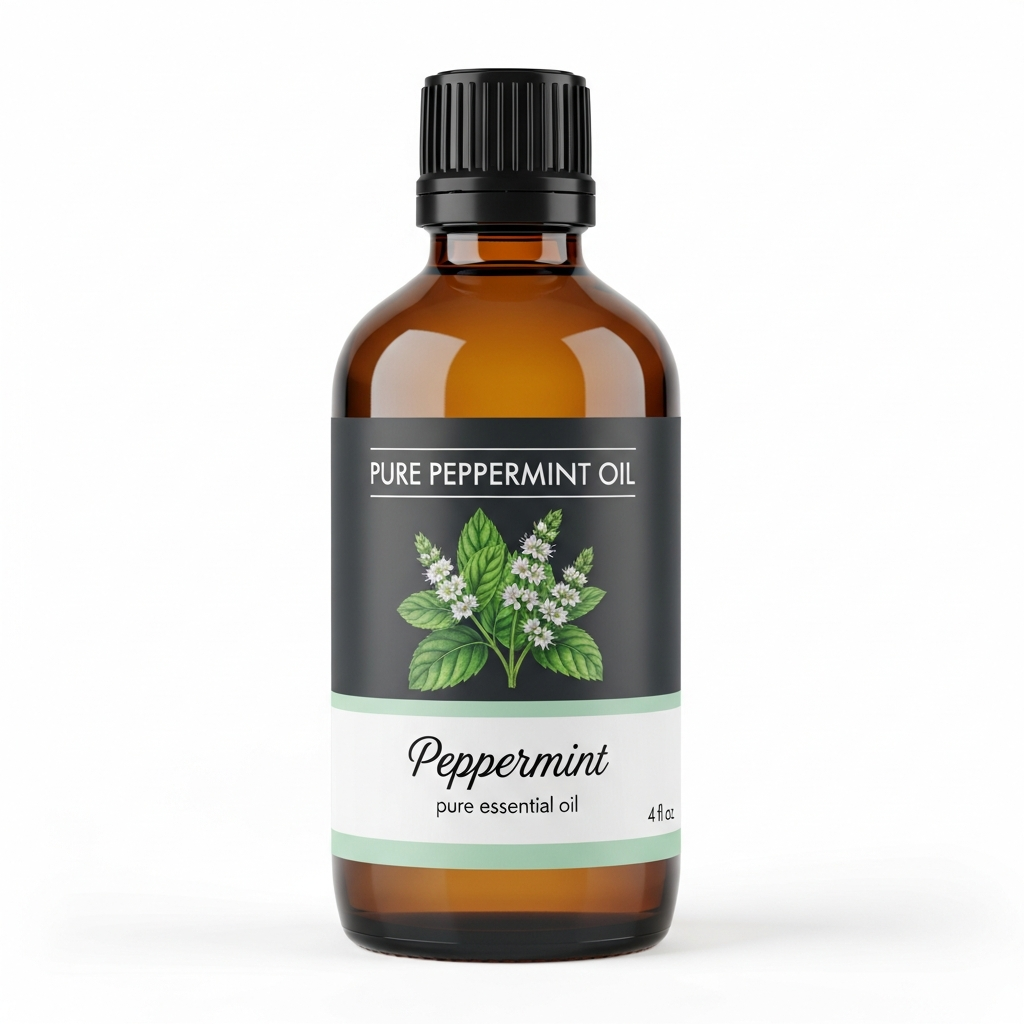
Peppermint Essential Oil
Our own Peppermint Essential Oil, in sizes from 0.5 oz to bulk.
From $10.99
Shop Now →Start with the percentage
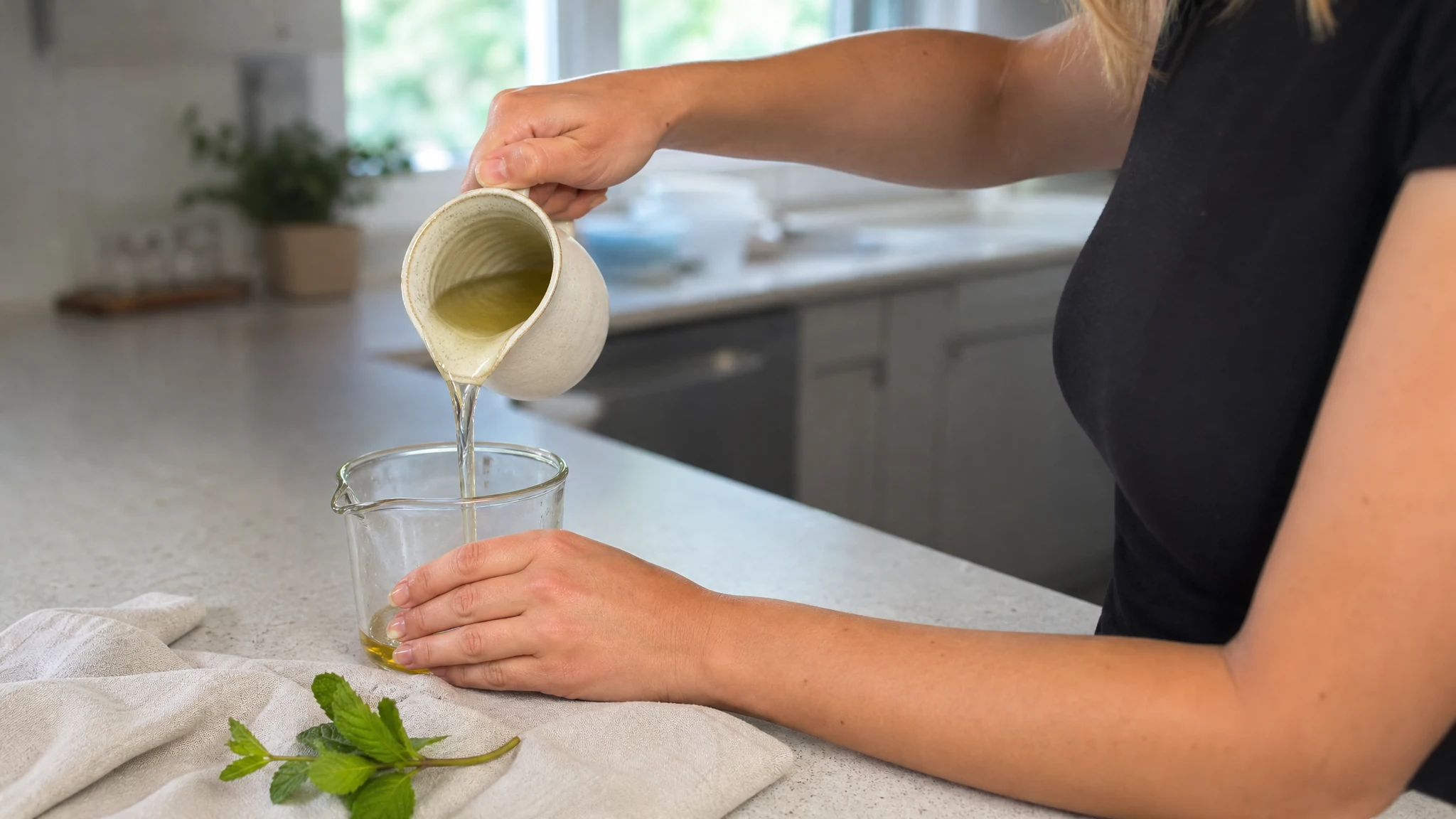
We sell our peppermint oils neat, so the dilution is yours to make. Our guidance is 0.5% to 2% in a carrier oil, with a patch test first. Peppermint is potent enough that one drop does the work of three of something gentler, which is why we reach for the low end of that range. The chart assumes 20 drops to the milliliter, a rough convention, and 29.57 ml to the ounce.
| Strength | In 10 ml carrier | In 1 oz | In 100 ml |
|---|---|---|---|
| 0.5% | 0.05 ml (1 drop) | 0.15 ml (3 drops) | 0.5 ml (10 drops) |
| 1% | 0.10 ml (2 drops) | 0.30 ml (6 drops) | 1.0 ml (20 drops) |
| 2% | 0.20 ml (4 drops) | 0.59 ml (12 drops) | 2.0 ml (40 drops) |
For anything larger than a roller bottle, weigh instead. The Cosmetic Ingredient Review (CIR) lists a specific gravity of 0.896 to 0.908 for peppermint oil in the USP specification. That is a general figure for the oil, not a measurement of ours, but it tells you a milliliter is about 0.9 g, so 1% of 100 g of finished blend is 1 g of oil. A kitchen scale that reads to 0.01 g takes the dropper out of the picture.
Why a drop is a slippery unit
The Tisserand Institute pulled together three studies, from 1999, 2000 and 2016, covering between 1 and 25 essential oils each. Across them, a milliliter held anywhere from about 20 to 40 drops, and the Institute's own chart assumes 30. Twenty drops averaged 0.66 g.
Here is what that spread does. Take "12 drops in an ounce." With a 20-per-ml dropper that is 0.6 ml, or 2%. With a 40-per-ml dropper it is 0.3 ml, or 1%. A chart built for one dropper and used with another is off by a factor of two, and the error lands on the strong side. By our arithmetic, 0.66 g per 20 drops at about 0.9 g/ml works out to roughly 27 drops per ml for peppermint oil, so the 20-drop convention in our chart errs on the cautious side for an average dropper.
Where 0.5% to 2% sits among published figures
The published numbers we can verify are general figures for Mentha piperita oil, and none of them is a limit for our oils. Every one sits above our range.
- 5.4% maximum dermal use level. Tisserand and Young's Essential Oil Safety recommends it, as reported by the CIR, and it is calculated from 8% menthofuran and 3% pulegone content, with limits of 0.5% for menthofuran and 1.2% for pulegone. The same authors advise avoiding the oil with cardiac fibrillation or glucose-6-phosphate dehydrogenase (G6PD) deficiency. It is a ceiling computed for one composition, not a target.
- 5% and 1.9% highest reported use. A 2017 industry survey in the CIR report found peppermint oil in face and neck leave-on products at up to 5%, and in rinse-off products at up to 1.9%. That records what manufacturers use, not a dose chosen for a home blend.
- Patch-test data. Two human repeated insult patch tests at 20% oil (104 and 101 people) reported no sensitization, while a North American Contact Dermatitis Group study at 2% in petrolatum found a positive reaction in 0.53% of 71 patients tested.
For cornmint (Mentha arvensis) oil we could not find a published maximum to quote, so the low end applies with even more reason. Our recommendation for face, scalp and body is 0.5% to 1%, treating 2% as the top of what we suggest. Keep every blend away from eyes, and keep it away from the face of an infant or young child. If a rash appears, stop and wash it off; a dermatologist or allergist can tell irritation from allergy. Our skin post and application post go further.
Oil into water floats
Dilution works in a carrier that dissolves the oil: vegetable oils and alcohol do, and water does not. PubChem lists menthol, the main component, at roughly 456 to 490 mg per liter of water at 25 C. A 1% mix in water would carry several grams of menthol per liter, many times what the water can hold, so the rest floats as droplets that reach skin undiluted. That is why sprays, baths and shampoos need an emulsifier or solubilizer made for essential oils, from a supply shop, used to its own directions. We do not sell those, so we leave the ratios to their makers.

Label the bottle when you make it
The most useful habit we can recommend is a boring one: put a label on the bottle the moment you finish mixing. Write the percentage, the carrier, the date and which of the two peppermint oils went in. Cornmint is bolder and sharper than piperita, so two bottles that both say 1% can still smell quite different, and you will want to know which is which. A strip of tape and a pen are all it takes.
Too many drops went in
You cannot take drops back out, but you can top up the carrier. In one ounce at 20 drops per ml:
| Drops added | Resulting strength | Carrier to add to reach 2% | Carrier to add to reach 1% |
|---|---|---|---|
| 6 | 1% | none needed | none needed |
| 12 | 2% | none needed | about 30 ml |
| 18 | 3% | about 15 ml | about 60 ml |
| 24 | 4% | about 30 ml | about 90 ml |
Those are straight arithmetic: divide the milliliters of oil by the strength you want, then subtract the volume you already have. Carrier choice also affects how long a blend keeps, which our carrier oil comparison covers.
Measure in percentages, write the percentage on the bottle, and your next batch will smell the same as this one, whatever dropper is in the drawer.
Peppermint Essential Oil
Peppermint Essential Oil from our own shop, in sizes from 0.5 oz to bulk.
From $10.99
Shop Now →Sources & Further Reading
- Cosmetic Ingredient Review, 2018. Amended Safety Assessment of Mentha piperita (Peppermint)-Derived Ingredients as Used in Cosmetics
- Tisserand Institute. How big is a drop?
- PubChem. (-)-Menthol, CID 16666, solubility record