How Peppermint Oil Is Made: Field, Still, Bottle
Peppermint oil is not pressed from the leaf or dissolved out of it. It is carried out by steam, caught as a liquid and skimmed off the water. Between the field and the bottle there are four physical steps, cutting, partial drying, distillation and separation, and each leaves a mark on the oil that a thoughtful buyer can ask about. Our Mentha piperita begins as steam-distilled foliage and our Mentha arvensis gives up its oil through steam distillation of the leaves, so this is the story behind both.
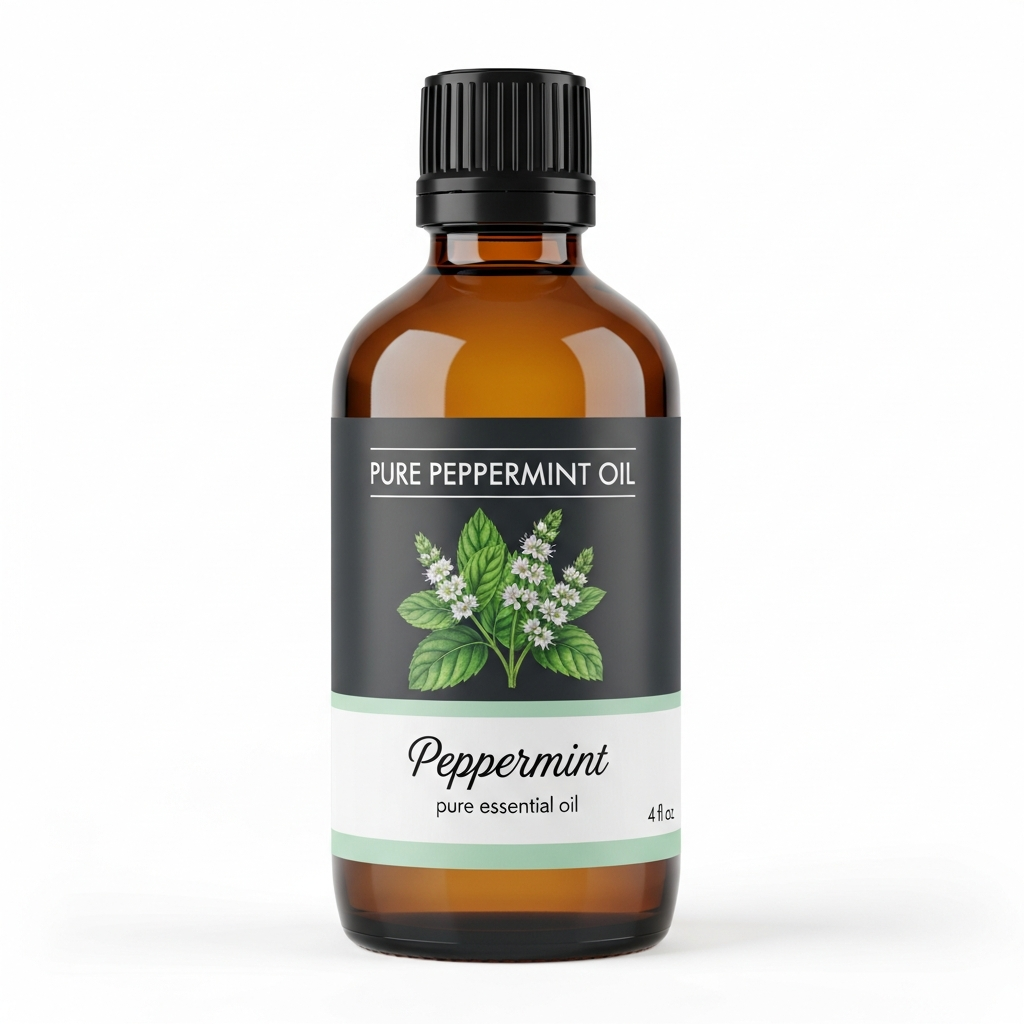
Peppermint Essential Oil
Our own Peppermint Essential Oil, in sizes from 0.5 oz to bulk.
From $10.99
Shop Now →Cutting when the crop is ready
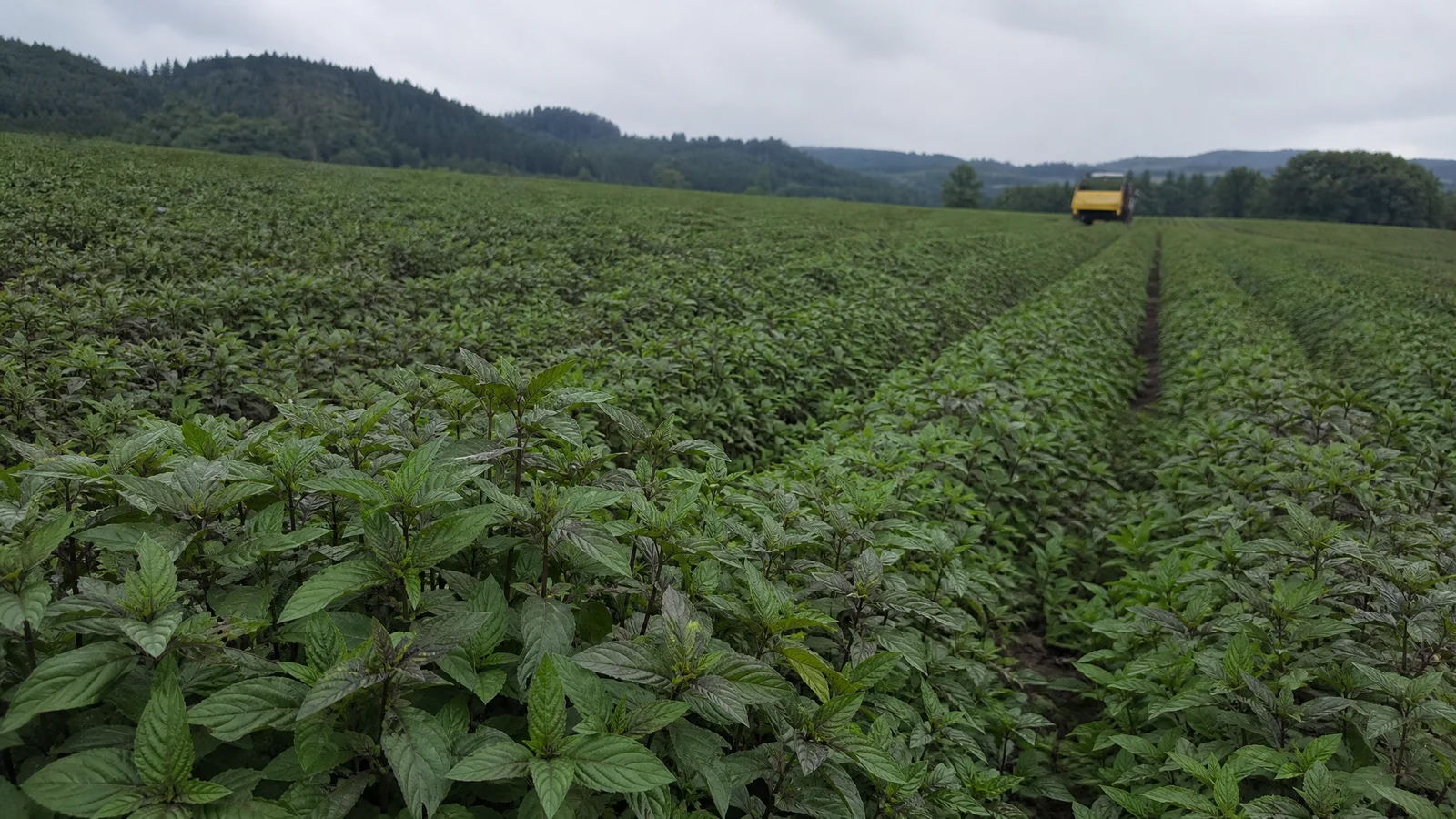
Purdue's extension page on mint oil says that optimum oil yield and quality come when about 10% of a peppermint crop is in full bloom, and that mint is cut and windrowed much as hay is (Purdue Extension). Timing matters because the leaf's chemistry moves through the season. A review of the two menthol mints reports that early peppermint herb is dominated by menthone (40 to 55%) with menthol near 20%, that menthol rises above 40% during shoot growth, and that menthofuran and pulegone rise toward flowering and fall afterward (Kalemba and Synowiec).
Reasoning from those two sources, a cutting date is a quality decision, because a crop cut at a different stage gives a different oil. It also explains why the menthol or menthone figure in a bottle belongs to a particular lot, and why general ranges, which blend many lots, are poor guides to the one you are holding.
Wilting in the field
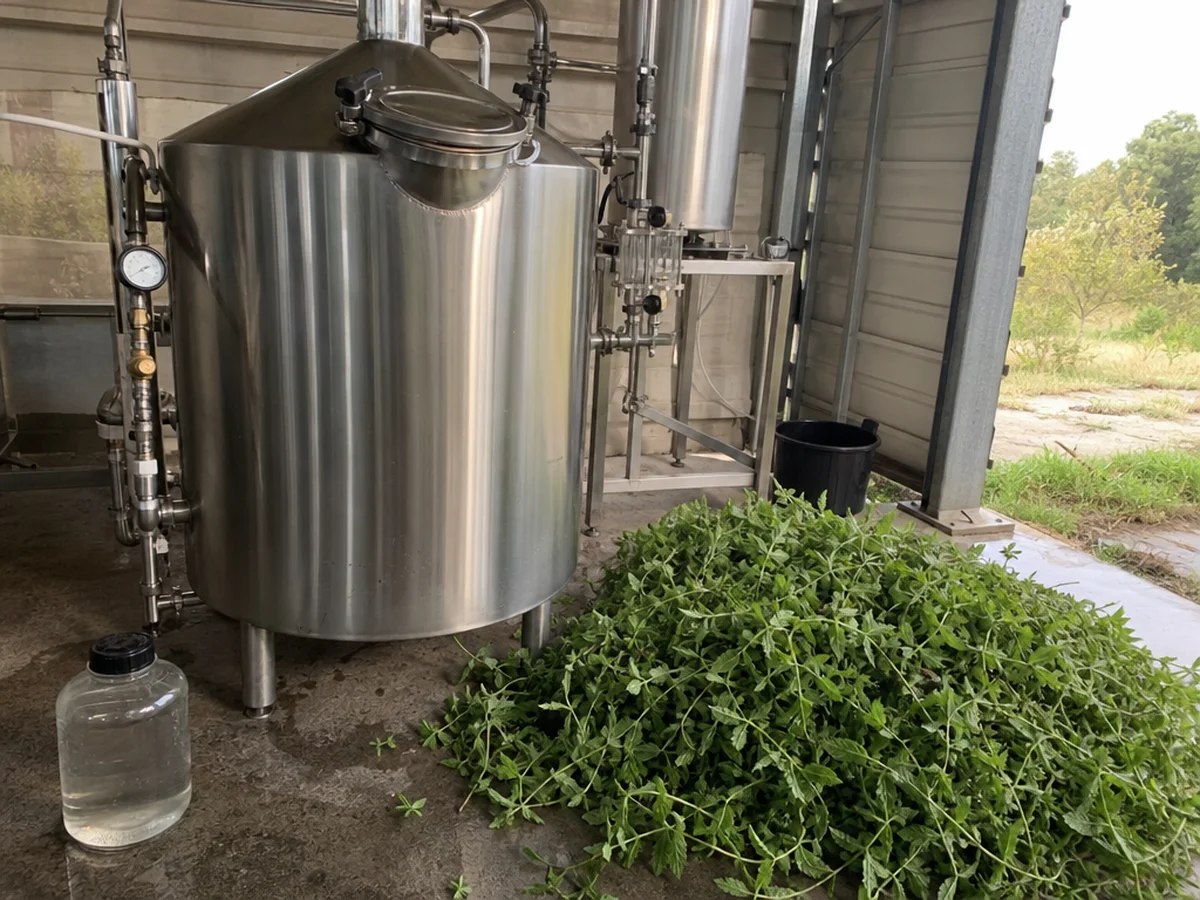
After cutting, the mint lies in windrows. Purdue says the foliage is allowed to partly dry for 24 to 48 hours, calls the field drying critical for maximum yield, and warns that if the leaves become too dry they shatter and oil is lost. Too green or wet, and distillation takes longer and the oil becomes harder to recover. Those are Midwestern figures from one extension page, so treat the hours as an example of the window rather than a universal rule. The takeaway is that the herb is wilted, not dried hard.
Steam through the herb
The cured hay goes into a tub with perforated steam lines at the bottom. Steam passes up through the herb and carries the oil with it into a water-cooled condenser, and from there into a receiver. That is steam distillation in a sentence. The review above reports a peppermint yield of 0.3% to 0.7% from fresh or partly dried flowering herb. If that percentage is by weight, which the review does not state, one 1 oz bottle (about 26.5 to 26.8 g of oil at the 0.896 to 0.908 specific gravity in the Cosmetic Ingredient Review report) takes roughly 3.8 to 8.9 kg of herb through the still. That is our arithmetic from general literature figures, not a figure for any lot of ours, but it makes a small bottle feel a good deal bigger.
Skimming the oil
Because the oil is lighter than water, it floats on top in the receiver, where it is recovered. That is why separation is a skimming job and not a filtering one. Purdue adds that mint oil can be kept two or more years if stored properly to reduce oxidation or heat deterioration, a point we take further in our shelf life article.
Why a second cut is a different oil
In Washington's Yakima region peppermint is cut twice a season. A 2011 study compared fresh and dried leaf from the July first cut and the September second cut, steam distilled each, and profiled the oils by GC-MS with a sensory panel (Chen and colleagues). The point we take from it is that the two harvests are analysed as separate oils, so a label that says only "peppermint oil" does not tell you which cut it came from. Our origin article looks at what a place name does and does not tell you.
Two mints, two crops
Cornmint is a different plant and a different crop. A paper on Indian menthol mint calls Mentha arvensis a short-term cash crop of 90 to 110 days and says India supplies about 80% of the world's mint oil, a figure it attributes to a 2020 source (Pandey and colleagues). Kalemba and Synowiec put cornmint oil's menthol above 60%, say menthol can be crystallised out of it, and report that the de-mentholised remainder is used as a cheap stand-in for peppermint oil. That is why species is a buying question and not trivia; our piperita and arvensis comparison sets the two side by side.
Why the still is worth picturing
It helps to picture the process when you next open a bottle. The scent you meet, crisp and cool with a faint sweetness on our piperita, began as green leaf and moving steam, and a good deal of plant stands behind each drop. When you measure oil out drop by drop, that is a handy reminder to go lightly. A bottle that took so much leaf to make deserves to be used a little at a time, and it is a good argument for starting at the low end of any recipe.
What to ask when you shop
Our documents are narrow: a Certificate of Analysis for a Mentha piperita sample reporting one refractive index, and a GC-MS report naming the Mentha arvensis oil with chemical-family totals. Neither says anything about cutting date, drying time or distillation. If you want those details, or menthol, menthone and pulegone figures for a lot, ask us in writing through the contact page and get the answer in writing before you order.
We do not give home-distillation instructions, since a still involves heat and flammable vapor. If you want to see a working operation, ask a local grower or distiller whether they take visitors. Our shop lists the peppermint oils we sell; larger sizes are on our bulk page, with a guide to buying peppermint oil in bulk.
Peppermint Essential Oil
Peppermint Essential Oil from our own shop, in sizes from 0.5 oz to bulk.
From $10.99
Shop Now →Sources & Further Reading
- Purdue University Extension. Indiana Mint Oil Production. ag.purdue.edu
- Kalemba D, Synowiec A, 2019. Agrobiological Interactions of Essential Oils of Two Menthol Mints: Mentha piperita and Mentha arvensis. Molecules. PMC6983130
- Chen MZ et al., 2011. Volatile compounds and sensory analysis of both harvests of double-cut Yakima peppermint (Mentha piperita L.). J Food Sci. Europe PMC, PMID 22417540
- Pandey P et al., 2022. Non-invasive Estimation of Foliar Nitrogen Concentration Using Spectral Characteristics of Menthol Mint (Mentha arvensis L.). Front Plant Sci. PMC9125156
- Cosmetic Ingredient Review, 2018. Amended Safety Assessment of Mentha piperita (Peppermint)-Derived Ingredients as Used in Cosmetics. cir-safety.org