Peppermint Oil and Cats: Why We Keep Them Apart
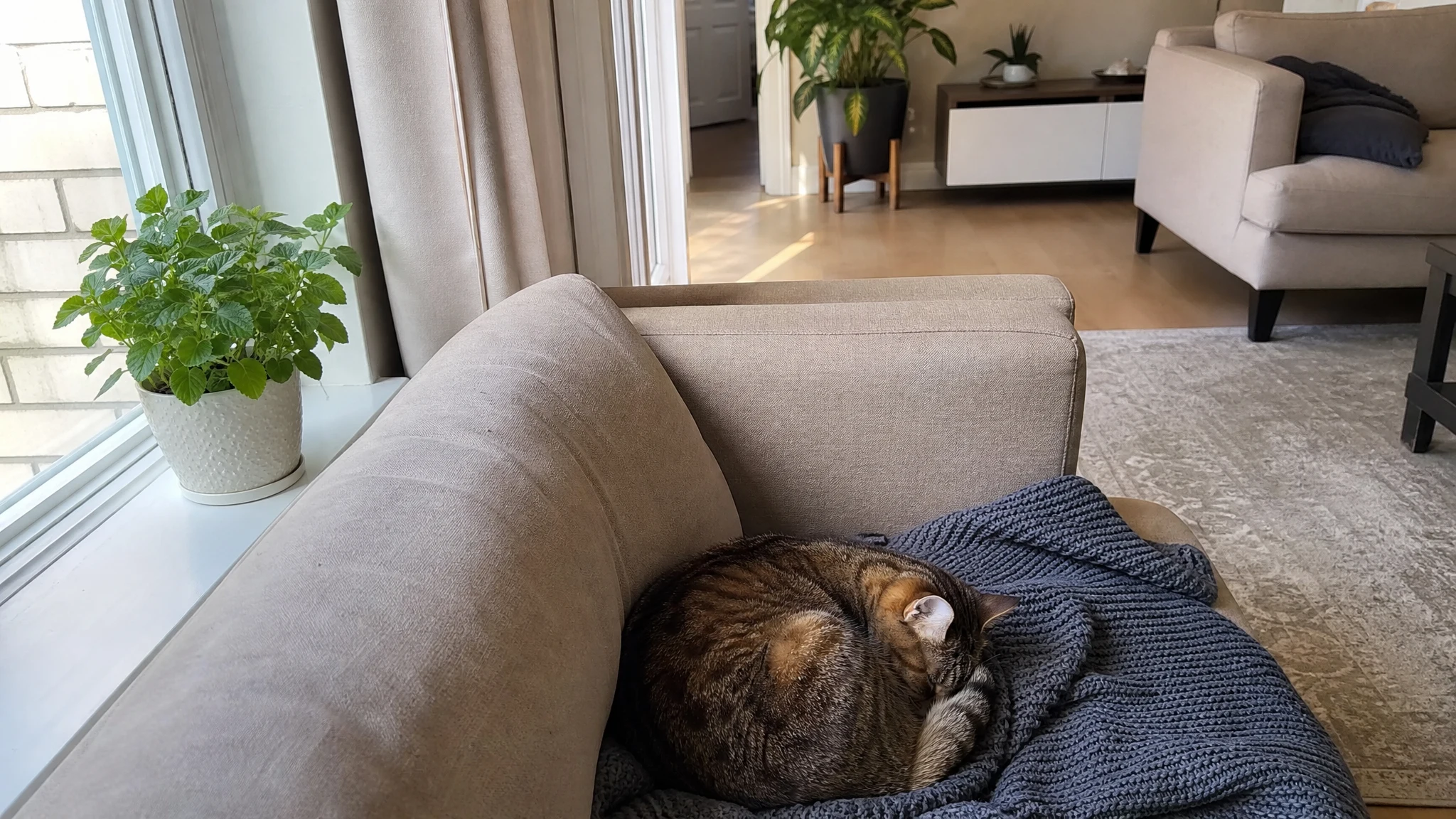
Cats are curious about everything on a counter: the open bottle, the cotton pad, the glass of water, the roller you just put down. That curiosity, plus the way cats groom every inch of themselves, is why we keep peppermint oil and cats well apart. Our recommendation is simple and does not depend on a single study: if a cat lives in your home, keep our oils away from the cat.
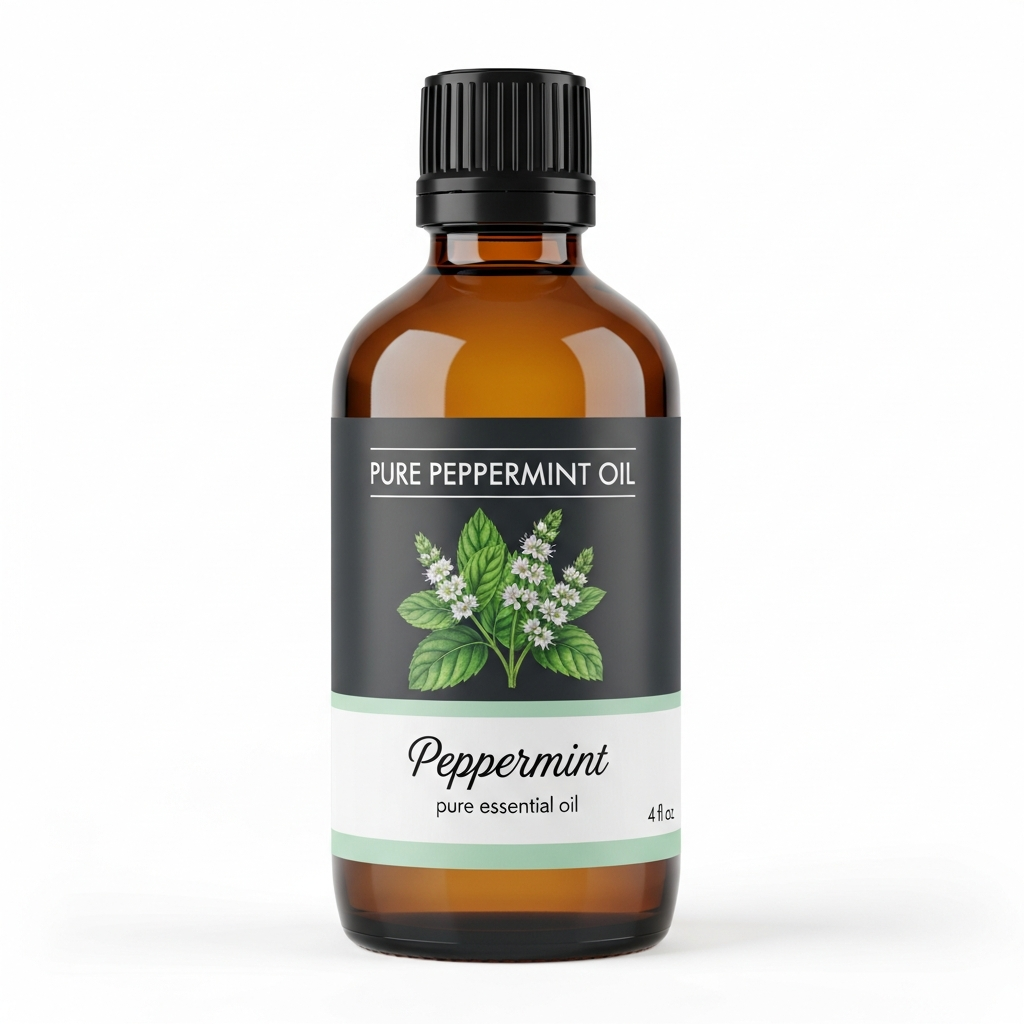
Peppermint Essential Oil
Our own Peppermint Essential Oil, in sizes from 0.5 oz to bulk.
From $10.99
Shop Now →What the cautious sources say
No published trial has tested peppermint oil around cats at household amounts, so everything we know is indirect, and it all points the same way. The Pet Poison Helpline says essential-oil toxicosis can affect all species but cats and birds are at the greatest risk. The ASPCA lists mint (Mentha species) as toxic to dogs, cats and horses, naming essential oils as the toxic principle. Both are general statements, and neither gives a safe level, so we do not invent one.
The most useful numbers come from ASPCA poison-control cases from 2006 to 2008 involving plant-based flea products made from essential oil mixtures (Genovese, McLean and Khan, 2012). It covered 39 cats and 9 dogs. Ninety-two percent showed at least one adverse effect, and 36 of the 39 cats were among them. Most signs began within 24 hours, and in more than three-quarters of cases the product had been used as labelled. Of 28 animals with a known outcome, half recovered with bathing alone, others needed veterinary treatment, and one cat died. The abstract does not name the oils, and a 2026 review lists peppermint among the oils found in such products (Bava and colleagues). So the study is a reason for care with oil products on cats, not a measurement of what peppermint alone does.
Why cats are different
You may have heard that cats lack a liver enzyme needed to process essential oils. The truth is a little more nuanced. A 2013 review explains that cats lack two glucuronidation enzymes, UGT1A6 and UGT1A9, and that the gap "appears to mainly affect compounds with a simple planar phenolic structure" (Court). That review does not mention essential oils. Menthol, the main component of peppermint oil, is a terpene alcohol and not a planar phenol, although the Cosmetic Ingredient Review notes that menthol glucuronide is the major biliary metabolite of menthol in other species. So glucuronidation is a reasonable explanation and not a proven one.
Regulators have not waited for a proof. When the European Food Safety Authority assessed peppermint oil as a feed additive in 2025, it raised the margin of safety for cats to 500 because of their reduced capacity for glucuronidation, and applied the same factor to a cornmint oil in 2026. Those opinions concern swallowed oil in feed, not skin or air, but they show a careful reading of the same problem.
Diffusers and sprays
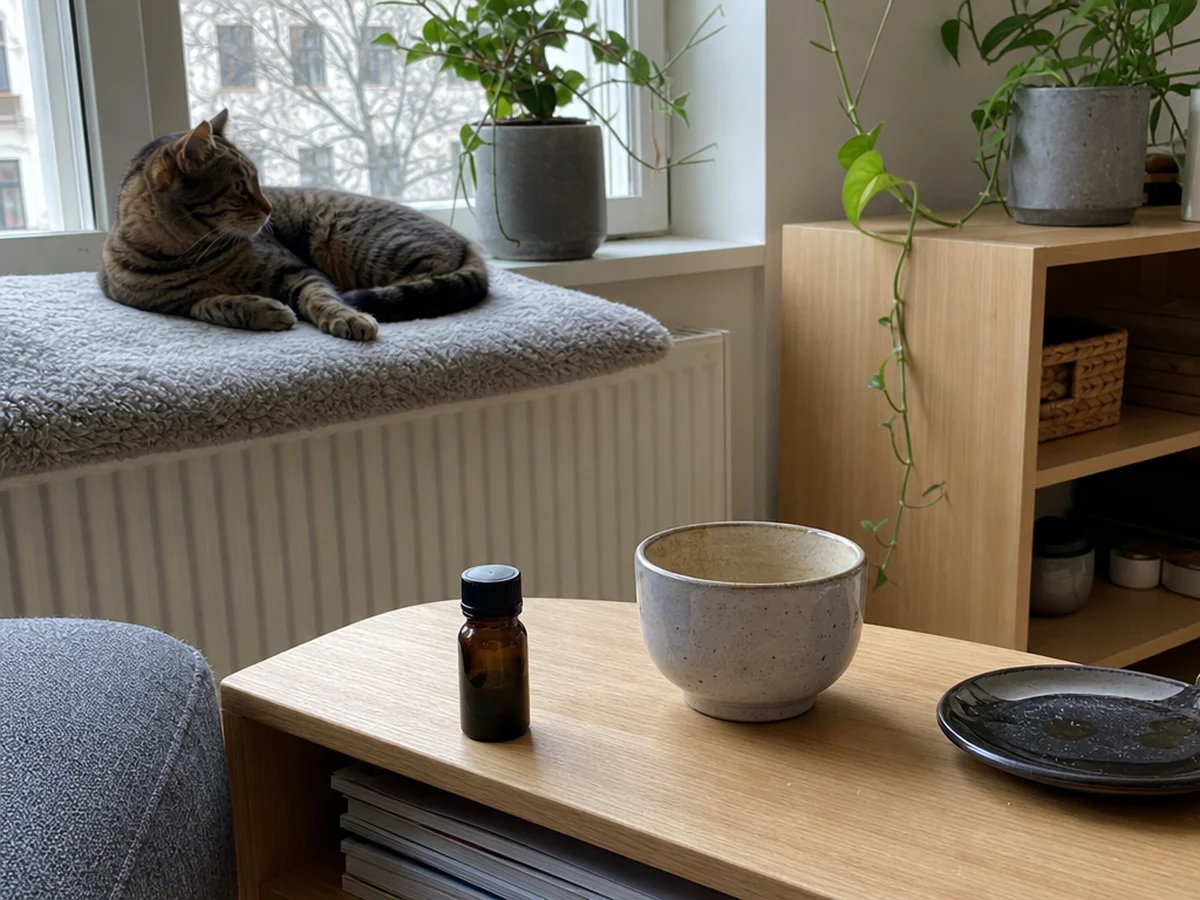
No study has measured peppermint oil diffused or sprayed around cats, so no safe airborne level is known. Our recommendation is to leave the diffuser off in any room where a cat lives, sleeps or cannot leave. A closed room gives a cat no way out of the air, and droplets that settle on fur or paws can be groomed off and swallowed. That second point is our reasoning and not a measured result. A shut door during the session and while the room airs is a simple habit, and our diffuser guide covers how much to use. Our spray article explains why we suggest going light with sprays.
What to look for, and who to call
The Pet Poison Helpline lists drooling, vomiting, lethargy, loss of appetite and irritation of the airways, skin and mucous membranes, usually within 6 to 8 hours. In the ASPCA series, agitation and hypersalivation were common in cats. A cat that seems fine right away is not necessarily in the clear, so a veterinarian is the right person to ask after any exposure.
Call your veterinarian or a poison line. The ASPCA Animal Poison Control Center is at (888) 426-4435 and says a consultation fee may apply, and the Pet Poison Helpline's medical line is (855) 764-7661. The helpline advises against inducing vomiting, because of the risk of aspiration. For skin exposure, its first aid is a bath with liquid dishwashing detergent; for swallowed oil, early dilution with water or food; and for inhaled oil, fresh air. Ask the line or your veterinarian which of these to do before you start. Poison Control says to keep essential oils "locked up, out of the sight and reach of children and pets", which is exactly how we store ours.
Making the home easy to live in
Small habits matter more than any one rule. Close the cabinet door fully, because cats are good with paws. Put the cap back the moment you finish measuring, wipe the neck of the bottle, and clear the counter of cotton pads, droppers and rollers before you leave the room. Wash your hands after handling the oil, especially before you stroke a cat, since fur picks up whatever your skin carries. If you have been mixing a blend or making soap, wipe down the workspace and let the room air out. And if you ever have a doubt about what your cat has touched, call your vet and describe it.
How we think about it
We sell peppermint oil for diffusing, diluted skin use and projects like soap and candles, sold neat, with guidance to dilute to 0.5% to 2% for skin and keep it away from pets. That dilution line was written for people. We do not extend it to animals, and we do not sell flea or pet products. Our companion article on dogs covers the same ground for canine households.
A latched cabinet and a diffuser in a room the cat never enters let you enjoy peppermint with confidence.
Peppermint Essential Oil
Peppermint Essential Oil from our own shop, in sizes from 0.5 oz to bulk.
From $10.99
Shop Now →Sources & Further Reading
- Genovese AG, McLean MK, Khan SA. Adverse reactions from essential oil-containing natural flea products exempted from Environmental Protection Agency regulations in dogs and cats. Journal of Veterinary Emergency and Critical Care, 2012.
- Court MH. Feline drug metabolism and disposition: pharmacokinetic evidence for species differences and molecular mechanisms. Veterinary Clinics of North America: Small Animal Practice, 2013.
- Bava R, et al. Essential Oils for Flea and Tick Control in Companion Animals: A Critical Review of Efficacy, Safety, Resistance Mitigation and Integrated Pest Management. Antibiotics, 2026.
- EFSA Panel on Additives and Products or Substances used in Animal Feed. Safety and efficacy of a feed additive consisting of an essential oil derived from the aerial parts of Mentha × piperita L. (peppermint oil) for use in all animal species (FEFANA asbl). EFSA Journal, 2025.
- EFSA Panel on Additives and Products or Substances used in Animal Feed. Safety and efficacy of a feed additive consisting of an essential oil derived from the flowering aerial parts of Mentha arvensis L. (cornmint oil) for use in all animal species (FEFANA asbl). EFSA Journal, 2026.
- Cosmetic Ingredient Review. Amended Safety Assessment of Mentha piperita (Peppermint)-Derived Ingredients as Used in Cosmetics (2018).
- Pet Poison Helpline. Essential Oils.
- ASPCA. Toxic and Non-toxic Plants: Mint.
- ASPCA. ASPCA Poison Control.
- Poison Control. Essential oils: Poisonous when misused.