Peppermint Oil Around Dogs: A Cautious Owner's Guide
Dogs investigate the world with their noses, and a bottle of peppermint oil is exactly the kind of thing that gets a lot of attention: strong, sharp and sweet. Our advice for dog households is to enjoy peppermint in places and ways your dog cannot reach. No source shows that peppermint oil is safe for dogs, and the few that speak to them lean toward caution, so here is how we think about a normal day with a dog and a bottle of oil.
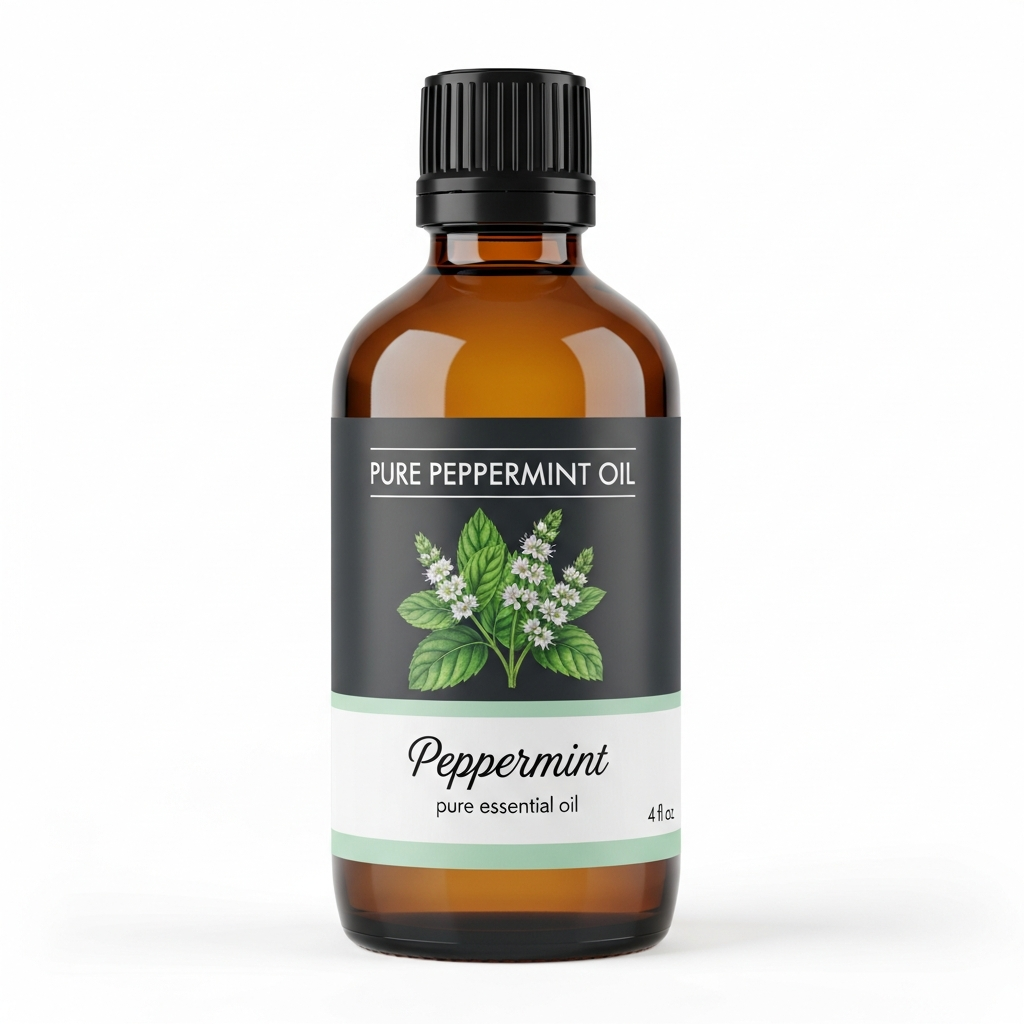
Peppermint Essential Oil
Our own Peppermint Essential Oil, in sizes from 0.5 oz to bulk.
From $10.99
Shop Now →What the research on dogs covers
No trial has put peppermint oil on, in or around dogs at household amounts. What exists is a poison-center case series, a plant listing, a general advisory on essential oils and a feed-additive opinion, each answering a narrower question than the one an owner has.
The case series is a review of ASPCA Animal Poison Control Center reports from 2006 to 2008 on plant-based flea products made of essential oil mixtures (Genovese, McLean and Khan, 2012). It covered 39 cats and 9 dogs. Eight of the nine dogs, 89%, had adverse effects, most often lethargy and vomiting. Most signs started within 24 hours, and among animals with a known outcome, one dog was euthanised. Nine dogs is a small group, the abstract does not break the mixtures into single oils, and the authors concluded these products can cause significant harm even when used as labelled. Read it as a reason for care with any oil product used on a dog, not as a measurement of peppermint on its own.
Beyond that, the ASPCA lists mint (Mentha species) as toxic to dogs, cats and horses, naming essential oils as the toxic principle, with vomiting and diarrhea after large ingestions. That is a plant page with no dose attached. The Pet Poison Helpline, which does not name peppermint, says essential-oil toxicosis can affect all species. We would never pretend to know a safe amount.
At home: the diffuser, the cleaner and the spill
If you diffuse peppermint, the plain approach is to run it where your dog is not, with the door shut, and let the room air before your dog returns. No study has measured peppermint oil diffused around dogs, so no safe level is known. What is documented is that a diffuser puts measurable material into room air; a chamber study of ultrasonic diffusers with lemon, lavender, eucalyptus and grapeseed oils measured volatile compounds and fine particles, and found tap water instead of deionised water raised fine particles fivefold for eucalyptus (Schwartz-Narbonne, Du and Siegel, 2021). No peppermint and no animals were involved, so we take only the general point. Our diffuser guide covers the drops and our room-by-room article covers the rest of the house.
Spills are the bigger practical matter. A dog that licks neat oil off a floor takes in far more than one that sniffs a diffuser, which is our own reasoning. Keep the bottle capped, upright and in a cabinet. Poison Control's advice about essential oils is that they should be locked up, out of the sight and reach of children and pets, and we follow it.
On the dog: fleas and doggy smells
We would not put peppermint oil on a dog for fleas or for odour. The 2026 flea-and-tick review (Bava and colleagues) says laboratory results for essential oils may be significantly overestimated and that real-world performance is hampered by their high volatility. Dogs also lick their coats, so oil on fur can end up swallowed. Our dilution guidance of 0.5% to 2% in a carrier oil is for adult human skin after a patch test; it was not written for animals and we do not extend it to them. We sell no flea or pet products, and a veterinarian is the right person to ask about fleas, coat or skin.
Habits that make a dog household easy
Most of the work is in small routines. Keep the bottle in a closed cabinet and not on a counter or a low shelf. Work over a tray when you measure drops, so a slip lands on something you can wipe up and bin. Wipe the rim of the bottle before you cap it, because a sticky bottle neck leaves oil on whatever it touches next. Wash your hands before you pet the dog or pick up its toys, and open a window while you work so the scent clears fast.
Guests deserve a thought too. A bag with an uncapped bottle in it is exactly the kind of thing a curious nose finds, so put it up where visiting dogs and children cannot get at it.
If your dog gets into it
Call your veterinarian or a poison line straight away. The ASPCA Animal Poison Control Center is at (888) 426-4435 and notes a consultation fee may apply, and the Pet Poison Helpline's medical line is (855) 764-7661. The helpline lists drooling, vomiting, lethargy, loss of appetite and irritation of the airways, skin and mucous membranes, usually within 6 to 8 hours, and says mild cases resolve in hours while severe ones can take three to seven days. Its guidance is not to induce vomiting, because of the risk of aspiration; for skin exposure to bathe with liquid dishwashing detergent, for swallowed oil to dilute early with water or food, and for inhaled oil to move to fresh air. A distressed dog may need a clinic rather than a bath, so ask the line or your vet which to do first. A dog that seems fine at first has not necessarily escaped.
The European Food Safety Authority's 2025 opinion on peppermint oil as a feed additive set a safe level for all animal species in complete feed, measured in milligrams per kilogram. That limit concerns a measured, swallowed dose in food. It is not a threshold for oil on a floor, a coat or the air. Our cat article goes through the additional reasoning for felines.
With a capped bottle on a high shelf, you and your dog can both be happy with the peppermint in your house.
Peppermint Essential Oil
Peppermint Essential Oil from our own shop, in sizes from 0.5 oz to bulk.
From $10.99
Shop Now →Sources & Further Reading
- Genovese AG, McLean MK, Khan SA. Adverse reactions from essential oil-containing natural flea products exempted from Environmental Protection Agency regulations in dogs and cats. Journal of Veterinary Emergency and Critical Care, 2012.
- Bava R, et al. Essential Oils for Flea and Tick Control in Companion Animals: A Critical Review of Efficacy, Safety, Resistance Mitigation and Integrated Pest Management. Antibiotics, 2026.
- Schwartz-Narbonne H, Du B, Siegel JA. Volatile organic compound and particulate matter emissions from an ultrasonic essential oil diffuser. Indoor Air, 2021.
- EFSA Panel on Additives and Products or Substances used in Animal Feed. Safety and efficacy of a feed additive consisting of an essential oil derived from the aerial parts of Mentha × piperita L. (peppermint oil) for use in all animal species (FEFANA asbl). EFSA Journal, 2025.
- Pet Poison Helpline. Essential Oils.
- ASPCA. Toxic and Non-toxic Plants: Mint.
- ASPCA. ASPCA Poison Control.
- Poison Control. Essential oils: Poisonous when misused.